Last updated: 7 November 2026
In short: LASIK is a laser eye procedure that reshapes the front surface of the cornea to correct short-sightedness, long-sightedness and astigmatism, so you depend less on glasses or contact lenses. It suits adults with a stable prescription and healthy, thick-enough corneas. It is not suitable for everyone, and a detailed screening is needed first. At Vision Plus Eye Centre in Noida, refractive screening is done at the Sector 51 and Gaur City-1 centres and surgery is done at the Sector 51 centre. Vision Plus offers LASIK, PRK (surface ablation) and ICL.
Book a LASIK assessment: +91 9717417417 or WhatsApp +91 8800313134.
What is LASIK and how does it work?
LASIK stands for laser-assisted in situ keratomileusis. The cornea is the clear front window of the eye and does about two thirds of its focusing. If the shape is slightly wrong, you need glasses. LASIK changes the shape in a controlled way.
In short, a thin hinged flap is lifted on the corneal surface, an excimer laser removes a very small, calculated amount of tissue underneath, and the flap is laid back. It heals without stitches. Short-sighted eyes are flattened. Long-sighted eyes are steepened. Astigmatism is evened out.
LASIK corrects the power of the eye. It does not treat cataract, glaucoma or retinal disease, and it does not stop presbyopia, the natural need for reading glasses after about 40 to 45. If your goal is chashma hatana (removing spectacles), read the options below before assuming LASIK is the answer.
LASIK, PRK, SMILE and ICL: options compared
No single procedure is right for everyone. The choice depends on your power, corneal thickness and shape, dryness, lifestyle and age. The table below is neutral, for understanding. It does not mean every procedure is offered at every centre.
| Procedure | How it works | Often suits | Points to know | Availability |
|---|---|---|---|---|
| LASIK | Corneal flap, laser reshaping underneath | Myopia, hyperopia, astigmatism with adequate corneal thickness | Quick visual recovery; flap-related issues, dryness more likely | Offered at Vision Plus |
| PRK / surface ablation | Surface layer removed, laser reshaping, no flap | Thin corneas, contact-sport or military jobs, mild to moderate power | Slower recovery, more discomfort in first days; no flap risks | Offered at Vision Plus |
| SMILE | Small lenticule cut inside the cornea and removed through a small opening | Myopia, with or without astigmatism | No flap; mostly for myopia; hyperopia is not treated | Not listed; ask the desk |
| ICL (implantable collamer lens) | A thin lens placed inside the eye, cornea not reshaped | Very high power, thin corneas, dry eyes | Intraocular surgery; endothelial and eye-pressure checks; higher cost | Offered at Vision Plus |
For more on lens implants, see our page on ICL surgery in Noida .
Am I eligible for LASIK? (Eligibility criteria)
You are likely to be a candidate if your eyes are healthy, your prescription is stable, and your corneas are thick and regular enough. Final suitability is decided only after tests.
| Criterion | Usual requirement |
|---|---|
| Age | 18 years or above; most surgeons prefer 21 or above, since power is stable later |
| Stable power | Prescription change of no more than about 0.5 dioptre in the last 12 months |
| Power range | Within the range the laser and your corneal thickness can safely treat (varies by platform and cornea) |
| Corneal thickness | Enough thickness to leave a safe corneal bed after treatment; thin or irregular corneas are screened out |
| Corneal shape | Regular on topography; keratoconus or early signs rule out LASIK |
| Dry eye | Mild dryness can be treated first; severe dry eye is a reason to avoid LASIK |
| Pregnancy and breastfeeding | Wait until after, since hormones can change power and healing |
| General health | No uncontrolled autoimmune disease or diabetes; no active eye infection |
| Eye health | No glaucoma, significant cataract or retinal problem |
Contact lens users must stop wearing them before the tests: roughly 1 to 2 weeks for soft lenses and 3 to 4 weeks or more for rigid lenses, as instructed. Lenses change the corneal shape and can distort the readings.
Who should not have LASIK?
Some people should avoid LASIK, and a good centre will say so plainly.
- Keratoconus, forme fruste keratoconus or other corneal ectasia
- Thin corneas or irregular corneal map
- Severe dry eye or untreated blepharitis
- Unstable or fast-changing prescription
- Pregnant or breastfeeding women
- Active eye infection or inflammation
- Uncontrolled autoimmune disease, or conditions that delay wound healing
- Advanced glaucoma, or retinal disease affecting vision
- Unrealistic expectations, for example perfect near and far vision after 45 without any glasses
Some people are better served by PRK, SMILE or ICL. Children and teenagers with changing power should not have laser correction; ask about myopia management for children instead.
The 7 pre-operative tests
A LASIK work-up usually takes 1.5 to 3 hours and includes dilating drops.
- Manifest and cycloplegic refraction: your exact power, with and without relaxing the focus muscle.
- Slit-lamp examination: checks the eyelids, tear film, cornea, lens and signs of infection.
- Corneal topography or tomography: maps the front (and back) shape of the cornea; the key test for ectasia risk.
- Pachymetry: measures corneal thickness at the centre and thinnest point.
- Pupil size measurement in dim light: large pupils can raise night glare after surgery.
- Dry eye tests: tear film break-up time and tear production (Schirmer), and ocular surface analysis.
- Intraocular pressure and dilated retinal examination: rules out glaucoma and retinal holes or thinning.
Depending on findings, an OCT, endothelial cell count or aberrometry may be added. Ask the front desk for the list of equipment available at your centre.
How LASIK is done: step by step
The laser portion takes only seconds per eye, and the whole process about 15 to 30 minutes for both eyes, although you spend 2 to 3 hours at the centre.
- Preparation. Antiseptic drops, numbing drops, and the eyelids kept open with a soft holder.
- Flap creation. A thin hinged flap is made, using a microkeratome blade or a femtosecond laser, and your surgeon will explain which method is planned for you. You may feel pressure and see dimness for a few seconds.
- Laser reshaping. The flap is lifted, and the excimer laser removes calculated tissue while you look at a light. An eye tracker follows small movements.
- Flap replacement. The flap is smoothed back and sticks on its own.
- Shields and drops. Protective shields are worn, and you are given antibiotic, steroid and lubricating drops.
Most patients describe a pressure sensation, not pain. Mild burning and watering for a few hours is usual. You are asked to rest with eyes closed afterwards.
LASIK recovery: what to expect
Vision is often clear within 24 hours, but the eye needs weeks to settle. Dryness is the most common side effect and can last for a few months.
| Time | What to expect | What to do |
|---|---|---|
| First few hours | Burning, watering, light sensitivity | Sleep or rest with eyes closed; wear shields |
| Day 1 | Check-up; vision usually much better | Start drops as instructed |
| First week | Mild dryness, glare, fluctuating clarity | No rubbing, no swimming, avoid dust and eye makeup |
| 1 month | Most daily activities normal | Contact sports only when cleared |
| 3 to 6 months | Dryness and night effects usually settle | Regular reviews until stable |
Screen use is fine in moderation within a day or two, with frequent blinking and lubricating drops. Driving is allowed when your vision meets the legal standard and your doctor clears it.
Risks and side effects of LASIK, honestly
LASIK is widely done and most patients are satisfied, but it is elective surgery with real risks, and outcomes cannot be guaranteed.
| Issue | What it is | How common (rough) | What can be done |
|---|---|---|---|
| Dry eye | Reduced tear stability after nerves in the cornea are cut | Common in the first weeks; many improve within 3 to 6 months; some stay dry | Lubricants, punctal plugs, medicines |
| Halos, glare, starbursts | Night-time light effects, often with large pupils | Common early, lasting in a smaller group | Usually settle; drops or glasses help |
| Under- or over-correction, regression | Power not exactly zero, or drifts back | Some patients; more likely in high power | Enhancement, if corneal thickness allows |
| Flap problems | Wrinkles, displaced flap, epithelial ingrowth | Uncommon | Re-lifting or cleaning the flap |
| Infection or inflammation | Corneal infection, diffuse lamellar keratitis | Uncommon | Intensive drops, early review |
| Ectasia | The cornea bulges and thins after surgery | Rare with careful screening, but can cause vision loss | Cross-linking (C3R), special lenses, sometimes transplant |
| Not 6/6 | Some people do not reach perfect vision | Possible | Glasses may still be needed |
Presbyopia still appears after 40 to 45, so you may need reading glasses later even after a good result. Some people are offered monovision (one eye for near); try it first with contact lenses.
LASIK cost in Noida
LASIK in Noida generally costs about Rs 30,000 to Rs 70,000 per eye for standard or wavefront-optimised treatment. Technology, pre-operative tests, enhancement policy and follow-up all influence the final number. See the LASIK surgery cost in Noida page for a price table and what is included. Indicative range, final quote after examination.
Our surgeon and centres
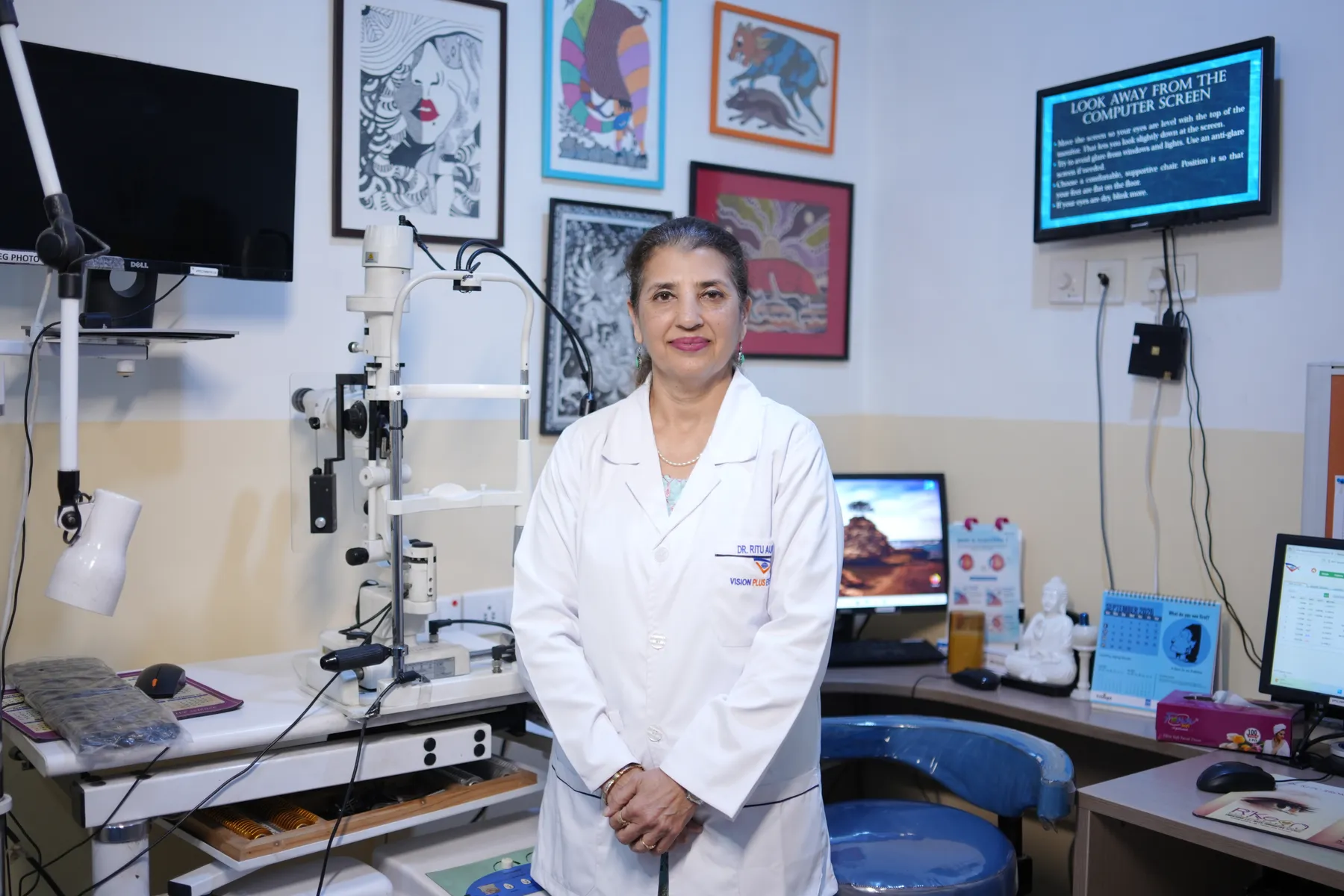
Refractive and cataract surgeon Dr. Ritu Aurora (Director) has more than 30 years of practice in Noida and Delhi, and her interests include refractive surgery (LASIK, PRK and ICL). Read her profile . Council registration no.: Delhi Medical Council, Reg. No. 22334 (2004).
Sector 51 (main centre): Kisan Tower, FF, SF & TF, Capt Shashikant Sharma Marg, Hoshiarpur, Sector 51, Noida 201301. Near Sector 51 metro. Mon to Sat 9:30 AM to 7:30 PM, Sun 10:00 AM to 4:00 PM.
Gaur City-1 (Noida Extension): Shop No. 213, Aarza Square-2, Plot No. CS-2, Gaur City-1, Sector 4, Greater Noida West 201309. Mon to Sat 10:00 AM to 7:00 PM, Sun closed.
Patients come from Sectors 50, 52, 62, 18 and 76, Indirapuram, Crossings Republik, Greater Noida, Ghaziabad and East Delhi.
When to see a doctor urgently
After any eye procedure, call the same day if you have increasing pain, rapid drop in vision, marked redness or discharge, or a new curtain or flashes. Before a procedure, sudden vision change needs checking and is not a reason to wait for an elective slot.
Frequently asked questions
What is LASIK, and can it remove my glasses?
LASIK is a laser procedure that reshapes the cornea to correct short-sightedness, long-sightedness and astigmatism. Many suitable patients are free of glasses for most tasks afterwards, though this is not guaranteed. After about 40 to 45 you may still need reading glasses.
Am I eligible for LASIK? What is the age limit?
You should be at least 18, ideally 21 or more, with a prescription stable for about a year, healthy thick corneas, and no keratoconus, severe dry eye or pregnancy. There is no fixed upper age, but cataract or presbyopia may point to other options. Tests decide.
What is the difference between LASIK and SMILE?
LASIK creates a corneal flap, and the laser works under it. SMILE removes a small piece of corneal tissue (lenticule) through a tiny opening, with no flap, and treats short-sight with or without astigmatism. SMILE avoids flap issues; LASIK treats a wider range of powers. SMILE is not listed as a service at Vision Plus; please ask the desk if you would like to know more.
Is LASIK safe? What are the side effects?
LASIK is widely performed and mostly safe in suitable eyes, but it has risks. Dry eye, halos at night and under- or over-correction are the commonest. Rare problems are flap complications, infection and corneal ectasia. Careful screening lowers risk; no result can be guaranteed.
Is LASIK painful?
The eye is numbed with drops, so most people feel pressure and some dimming of vision, not pain. After the procedure there can be burning, watering and light sensitivity for a few hours. Mild discomfort usually settles overnight. Tell the surgeon at once if you feel pain during the procedure.
How long does LASIK take?
The laser treatment takes seconds per eye, and the whole procedure about 15 to 30 minutes for both eyes. You will spend around 2 to 3 hours at the centre for preparation, treatment and a short rest. Pre-operative tests are done on a separate earlier visit or the same day.
What is the recovery time, and when can I go back to work and drive?
Vision is often clear by the next day. Most people return to desk work in 1 to 3 days, and drive once the doctor clears them, often within a few days. Swimming, eye makeup and contact sports are paused for a few weeks. Dryness can continue for several months.
Can my power come back after LASIK?
A small number of people see some regression, especially after high-power correction or if the prescription was not stable before surgery. Ageing changes, such as presbyopia and cataract, are not stopped by LASIK. If the cornea is thick enough, a touch-up may be possible.
How much does LASIK cost in Noida?
LASIK in Noida generally costs about Rs 30,000 to Rs 70,000 per eye for standard treatment, and more for advanced options. Price depends on technology, tests and follow-up. Indicative range, prices reviewed November 2026; final quote after examination. See the cost page for details.
How do I book a LASIK assessment near Sector 51 or Noida Extension?
Call +91 9717417417 or WhatsApp +91 8800313134. Visit the Sector 51 or Gaur City-1 centre for the pre-LASIK work-up. Stop contact lens use as advised, bring your old glasses and prescriptions, and plan for dilating drops, which blur vision for several hours.
Book your refractive assessment
The first visit tells you whether LASIK, PRK, SMILE, ICL or simply glasses is the most suitable, and the reasons.
- Surgery consultation: +91 9717417417
- Appointment desk and WhatsApp: +91 8800313134
- Email: wecare@visionplus.net.in
Medically reviewed by Dr. Ritu Aurora, November 2026