

Last updated: 7 November 2026
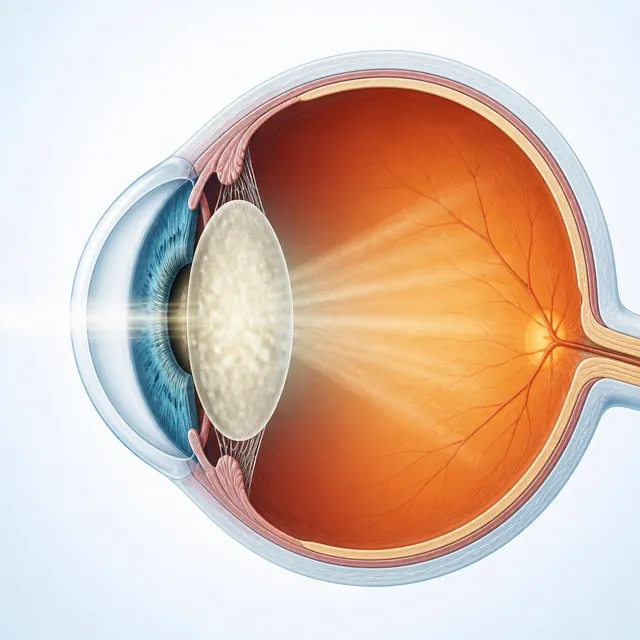
A cataract (motiyabind, or safed motia) is a clouding of the eye's natural lens, which sits behind the pupil. It makes vision hazy, dull and glary, as if looking through a dirty windscreen. It develops slowly, usually after 50, does not spread from one eye to the other as an infection would, and is corrected only by surgery. This page explains the signs, causes and the point at which treatment makes sense.
Symptoms of cataract
The lens focuses light on the retina. When proteins in it clump, light scatters. Early symptoms are easy to dismiss as "needing new glasses".
| Stage | What you may notice |
|---|---|
| Early | Slightly blurry or dull vision; glare from headlights; haloes around lights; colours look faded or yellowish; frequent change of glass power; improved near vision in some (called "second sight") |
| Moderate | Difficulty driving at night; trouble reading small print; double vision in one eye; need for strong light to read |
| Advanced | Whitish or brownish pupil; vision limited to light and shapes; daily tasks unsafe |
Cataract is painless. Pain, redness or headache with a hazy eye points elsewhere.
When to see a doctor urgently
Sudden loss of vision, eye pain with a red eye and nausea, flashes of light or a shadow across vision are not routine cataract symptoms. They can signal acute glaucoma or retinal detachment and need a same-day examination. A white pupil in a baby or child also needs prompt review.
Causes and risk factors
Age is the main cause: most people have some lens clouding by their 60s. Other factors that bring cataract earlier include:
- Diabetes (earlier and faster cataract; see diabetic retinopathy )
- Long-term steroid use in drops, tablets, inhalers or injections
- Prolonged unprotected sunlight (UV) exposure
- Family history and high short-sightedness
- Congenital cataract, present from birth or developing in childhood
Types of cataract
| Type | Where it forms | Typical effect |
|---|---|---|
| Nuclear | Centre of lens | Slow blur, brown tint, distance vision hit first |
| Cortical | Edges, spoke-like | Glare, haloes |
| Posterior subcapsular | Back of lens | Fast; trouble in bright light and reading; common in diabetes and steroid use |
| Congenital | From birth or childhood | Needs early assessment to protect development of vision |
How it is diagnosed
A cataract is diagnosed at the eye OPD with a visual acuity test, slit lamp examination and a dilated look at the lens and retina. Before surgery, measurements of the eye (biometry) select the lens power, and a retina check ensures that cataract is the only reason for poor sight. Glaucoma and macular conditions can look like cataract, which is why a full check matters. See glaucoma and macular degeneration .
Treatment: what works and what does not
No eye drop, supplement or exercise dissolves a cataract. Drops sold for this purpose have not been shown to work. In the early stage, new glasses, anti-glare coating and brighter lighting help. Once the cataract interferes with your work, driving, reading or safety, surgery is the treatment. Modern surgery is phacoemulsification: a small incision, the clouded lens is broken and removed, and a foldable intraocular lens (IOL) is placed. It is usually day-care. Read the complete procedure, lens choices and costs on our cataract surgery in Noida page . Indicative price ranges are in the eye treatment cost guide .
What Vision Plus does
Cataract is the core of Dr. Ritu Aurora's practice. She began phacoemulsification in 1997 and has operated on adult, paediatric and complicated cataracts. You can see her at our Sector 51 centre, close to Sector 51 metro, or at Gaur City-1 for Noida Extension residents. Dr. Ritu Aurora's profile .
Prevention and living with it
You cannot fully prevent age-related cataract, but you can delay it: wear UV-protective sunglasses, do not smoke, keep blood sugar controlled, avoid unsupervised steroid drops, and treat eye injuries promptly. Have an eye check yearly after 40, or earlier if you have diabetes.
Frequently asked questions
What does an early cataract feel like?
Usually a soft haze, glare from oncoming headlights, faded colours and a glass number that keeps changing. Both eyes may be affected unequally. It is painless. If these appear, an eye check will confirm whether it is cataract or something else.
Can cataract be treated without surgery?
No medicine can clear a cataract. Glasses and stronger light may help early on, but they do not remove it. Surgery replaces the cloudy lens with a clear artificial lens, and it is the only proven treatment.
Is cataract surgery safe?
It is one of the most common and well-studied surgeries, and most patients do very well. Like all surgery it has risks, such as infection or inflammation, which your surgeon will explain. Outcomes depend on the eye's health and surgeon planning.
When is the right time to have cataract surgery?
When blurred or glary vision affects what you need to do: driving, reading, work or safe walking. You do not need to wait until it is mature. Earlier surgery in a softer cataract is often easier.
Can a cataract grow back?
The removed lens does not return. Some people develop a haze on the thin capsule that holds the new lens, called posterior capsule opacification, months or years later. A quick laser procedure clears it.
Where can I get my cataract checked in Noida?
Book with Dr. Ritu Aurora at Vision Plus, Sector 51 (Kisan Tower) or Gaur City-1, Noida Extension. Call or WhatsApp +91 8800313134, or use our appointment page . For eye surgery consultation call +91 9717417417.
Book a cataract check-up
Blurred vision should be assessed before it is assumed to be cataract. Call +91 8800313134 or book online . Sector 51: Mon to Sat 9:30 AM to 7:30 PM, Sun 10:00 AM to 4:00 PM. Gaur City-1: Mon to Sat 10:00 AM to 7:00 PM. More in our eye diseases library .
Medically reviewed by Dr. Ritu Aurora, November 2026