
Last updated: 7 November 2026
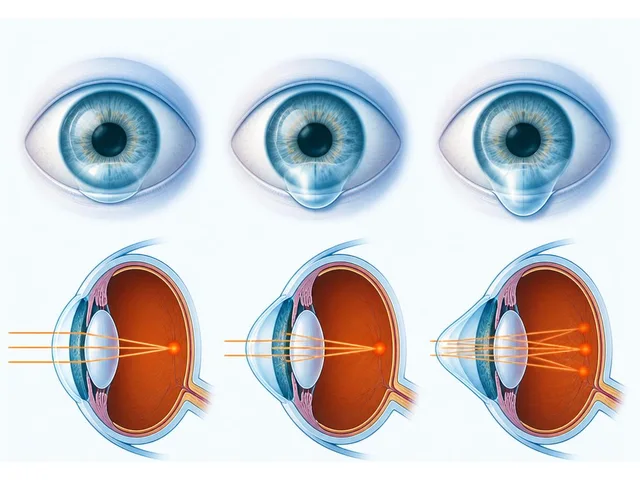
Keratoconus is a condition in which the clear front window of the eye (the cornea) thins and bulges into a cone shape. This distorts vision, and glasses stop working well. Treatment depends on the stage: corneal cross-linking (C3R) strengthens the cornea and aims to stop it getting worse, special lenses improve vision, and rings or a corneal transplant are reserved for advanced cases. C3R costs indicatively Rs 15,000 to 35,000 per eye in Noida.
Early detection matters most. Keratoconus usually begins in the teens or twenties, and is easiest to treat before the cornea has scarred.
Keratoconus symptoms
The typical sign is vision that keeps changing and cannot be fully corrected by glasses. Look out for:
- Glasses power, especially cylinder (astigmatism), changing every few months
- Blurred or distorted vision, ghost images, streaks around lights
- Glare, halos and trouble driving at night
- Frequent eye rubbing and itching
- Light sensitivity
- Sudden clouding of vision in advanced disease (acute hydrops)
Children and teenagers who rub their eyes constantly, have allergy, or have a family history should be screened with a corneal topography test. This is a map of the cornea's shape that picks up changes before they are obvious to the eye.
Stages of keratoconus
Keratoconus is graded by corneal curvature, thickness, scarring and the power of glasses needed. The grading below is a simplified summary based on commonly used staging. Your doctor uses scan results to place you accurately.
| Stage | Features | Usual approach |
|---|---|---|
| Suspect or early | Mild irregular shape on topography, good vision with glasses | Watch closely, repeat scans, control allergy and rubbing, C3R if progression is documented |
| Mild to moderate | Steeper curvature, thinner cornea, astigmatism and myopia, vision needs RGP or special lenses | C3R to stop progression, then glasses or lenses. Rings in selected cases |
| Advanced | Marked steepening and thinning, vision poor even with lenses, lens intolerance | C3R if thickness allows, rings, scleral lenses |
| Severe | Very steep and thin cornea, scarring, risk of hydrops | Corneal transplant (lamellar DALK or full-thickness) |
C3R (corneal cross-linking) explained
C3R strengthens the cornea by forming extra bonds between its collagen fibres. Vitamin B2 (riboflavin) drops soak into the cornea and are then activated with controlled ultraviolet-A light. The aim is to stop keratoconus from progressing. It does not remove the cone, and it does not reverse the shape.
In the most common "epi-off" method:
- Eye drops numb the eye. The thin surface layer (epithelium) is gently removed so the riboflavin can enter.
- Riboflavin drops are applied for about 30 minutes.
- UV-A light is delivered for around 10 to 30 minutes, depending on the protocol.
- A bandage contact lens is placed and removed after a few days.
The procedure is generally done in about an hour, as a day-care procedure, one eye at a time. Discomfort, watering and light sensitivity are common in the first 3 to 5 days. Vision is hazy for a few weeks and then improves, and the cornea continues to settle for months. A minimum corneal thickness is needed for safe treatment in the epi-off method. Some patients with thin corneas need modified protocols. Risks include infection, corneal haze or scarring, and in rare cases continued progression, so follow-up scans are essential.
Rings, ICL and transplant
When C3R is not enough or the cornea is too advanced, other options come in.
- Intracorneal ring segments (such as Intacs). Small plastic arcs placed in the cornea flatten the cone and may improve vision and lens tolerance. They are often combined with C3R. They do not stop progression on their own.
- ICL for stable keratoconus. In selected stable patients, an implantable lens can correct high power. It is not for progressing eyes. Please ask the desk whether this option is suitable for you.
- Corneal transplant (keratoplasty). For scarred or very thin corneas. Deep anterior lamellar keratoplasty (DALK) replaces the front layers and keeps the patient's own inner lining, so the risk of rejection is lower. Full-thickness (penetrating) keratoplasty is used when the inner layers are also affected. Recovery is long, and glasses or lenses are usually needed afterwards.
- Contact lenses. RGP and scleral lenses give the sharpest vision for many patients, and can be used before and after other treatments. See contact lens fitting .
LASIK and other laser vision correction are not suitable for keratoconus because they thin the cornea further. This is why anyone considering LASIK should have a corneal topography first. See LASIK .
Why you must stop rubbing your eyes
Eye rubbing is strongly linked to keratoconus. It is one of the most common risk factors, along with allergy, atopy and family history, and it can speed up progression in an eye that already has it. Rubbing pushes on a weakened cornea and releases enzymes that harm collagen.
What helps: treat allergy (drops, cold compresses, dust control), treat dry eye, wear protective glasses when playing, avoid sleeping face down on the hands, and remind children kindly. Ask your doctor for safe antiallergy drops rather than rubbing. See dry eye treatment .
Keratoconus treatment cost in Noida
C3R in Noida costs indicatively Rs 15,000 to 35,000 per eye, rings Rs 40,000 to 70,000 and a corneal transplant Rs 40,000 to 1,50,000 depending on type and tissue.
| Treatment | Indicative cost |
|---|---|
| Corneal topography scan (diagnosis) | Rs 1,000 to 2,500 |
| C3R (corneal cross-linking) | Rs 15,000 to 35,000 per eye |
| Corneal transplant (DALK, penetrating and others) | Rs 40,000 to 1,50,000 (indicative national range) |
Prices reviewed: November 2026. Final cost depends on the protocol, one or both eyes, the type and availability of tissue, the surgical technique and follow-up needs. CGHS and cashless insurance support is available, confirm panel at the desk.
When to see a doctor
Book an examination promptly if you notice glasses power changing repeatedly, ghosting that glasses do not fix, or a family history with symptoms. Come the same day for sudden blurring with pain and a cloudy cornea, or a red painful eye in someone who wears contact lenses.
Frequently asked questions
What is keratoconus?
Keratoconus is a condition in which the cornea thins and bulges into a cone, distorting vision. It usually starts in the teens or twenties and may progress for years. Symptoms include frequently changing glasses, ghost images, glare and light sensitivity. It is diagnosed with a corneal topography scan.
Does eye rubbing cause keratoconus?
Rubbing is strongly linked with it, along with allergy and family history, and it can speed progression. It is probably not the only cause. Stopping the habit, treating allergy and dry eye, and seeing a doctor if you notice vision changes reduce the risk of worsening.
Can keratoconus be cured or reversed?
No treatment makes the cornea fully normal again. C3R aims to stop it from progressing, and lenses, rings or a transplant improve vision. The best results come from treating early, before scarring sets in. Regular scans track the cornea and show whether it is stable.
Is C3R cross-linking safe, and does it hurt?
C3R is a well-studied procedure and is generally safe when done by a trained surgeon with the right corneal thickness. Numbing drops are used, but discomfort and watering in the first 3 to 5 days are common. Rare risks include infection, haze or scarring.
Who needs C3R, and when?
C3R is advised when keratoconus is progressing on repeat scans or is already moderate, especially in young patients, as progression is faster at younger ages. Your doctor compares scans over time. In some children, treatment is advised earlier. Very thin corneas may need a modified approach.
What is the recovery time after C3R?
Expect discomfort for 3 to 5 days while the surface heals, with a bandage lens removed at the first review. Vision may be blurred for weeks, and you must avoid rubbing, water and dust during recovery. Final stability is judged on scans after several months.
When are rings or a corneal transplant needed?
Rings are considered when contact lenses are not tolerated or vision stays poor despite C3R. A transplant is for advanced keratoconus with scarring or a very thin cornea, when other options will not work. Most patients never need a transplant if treated early.
What is the cost of C3R and keratoconus treatment in Noida?
C3R is indicatively Rs 15,000 to 35,000 per eye. Rings or ICL for keratoconus are about Rs 40,000 to 70,000, and a corneal transplant Rs 40,000 to 1,50,000. Final cost depends on the protocol and technique. CGHS and cashless insurance support is available; confirm panel at the desk.
Where can I get keratoconus treatment in Noida?
You can have a corneal scan and consultation at our Sector 51 centre (Kisan Tower, near Sector 51 metro) or at Gaur City 1 in Noida Extension. Call or WhatsApp +91 8800313134. For surgery consultation, call +91 9717417417.
Book a keratoconus consultation
- Sector 51 centre: Kisan Tower, FF, SF & TF, Capt Shashikant Sharma Marg, Hoshiarpur, Sector 51, Noida 201301. Mon to Sat 9:30 AM to 7:30 PM, Sun 10:00 AM to 4:00 PM.
- Gaur City centre: Shop No. 213, Aarza Square-2, Plot No. CS-2, Gaur City-1, Sector 4, Greater Noida West 201309. Mon to Sat 10:00 AM to 7:00 PM, Sun closed.
- Appointments and WhatsApp: +91 8800313134. Eye surgery consultation: +91 9717417417. Email: wecare@visionplus.net.in
Last reviewed: November 2026