

Last updated: 7 November 2026
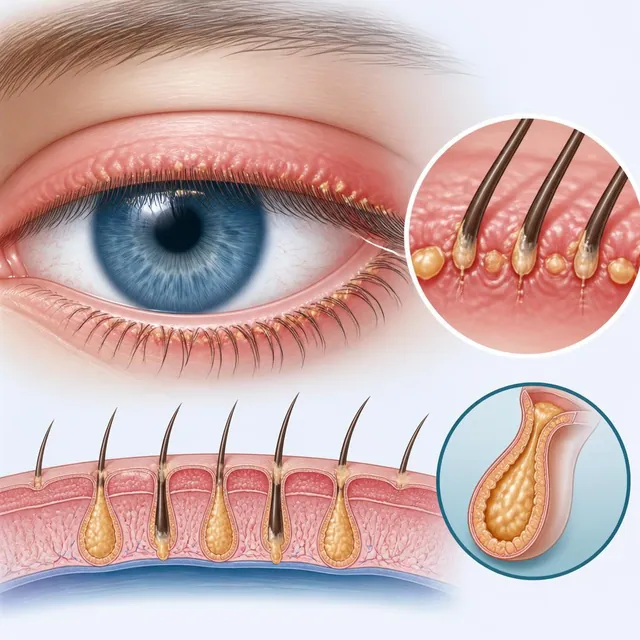
Blepharitis is long-term inflammation of the eyelid margins, the edges where the eyelashes grow. It causes red, itchy, crusty lids and a gritty feeling in the eyes. It is very common, it is not contagious, and it is usually controlled rather than cured, with daily lid care as the foundation of treatment.
Symptoms
- Red, swollen or thickened eyelid edges
- Flakes or crusts on the lashes, especially on waking
- Burning, itching or a sandy, gritty sensation
- Recurrent styes or chalazia (firm lumps within the lid)
- Vision that blurs on blinking and then clears
Red flags
See a doctor soon if there is pain, light sensitivity, falling vision, or a lump on one eyelid that keeps coming back in the same spot. A persistent one-sided lid lump with lash loss, especially in older adults, needs examination to exclude rare lid tumours.
Types and causes
The condition is named by where it sits:
| Type | Where | Common cause | Typical signs |
|---|---|---|---|
| Anterior blepharitis | Front lid edge, around lashes | Staphylococcal bacteria, seborrhoeic dermatitis (dandruff), Demodex mites | Crusts, collarettes (sleeve-like scales) at lash roots |
| Posterior blepharitis | Inner lid edge, oil glands | Meibomian gland dysfunction (blocked oil glands) | Frothy tears, oily or foamy lids, chalazia, dry eye |
Risk factors include oily skin, dandruff, rosacea, allergy, long hours on screens (less blinking) and contact lens wear. Many people have both types together.
How it is diagnosed
Diagnosis is made at the eye OPD with a slit lamp examination of the lid margin, lashes and oil gland openings. The doctor may press the lid to see the quality of oil and check tear stability. Lash sampling for Demodex can be done where needed. No special lab test is usually required.
Treatment: what works
Daily lid hygiene is the most important step. Medicines help when it is not enough.
Home routine (2 times a day at first)
- Apply a clean warm compress over closed lids for 5 to 10 minutes to melt thickened oil.
- Gently massage the lids towards the lashes for 30 seconds.
- Clean along the lash roots with a lid-cleaning wipe or a cotton bud dipped in diluted baby shampoo or a prescribed lid cleanser.
- Wash your hands first and use a fresh bud for each eye.
Medical treatment
- Antibiotic eye ointment or drops for a short course in flare-ups
- Lubricating drops (preservative-free preferred) for dryness
- Low-dose oral doxycycline or azithromycin for stubborn posterior disease, sometimes for weeks to months, if the doctor judges it suitable
- In-clinic procedures for blocked glands (intense pulsed light and lid-margin treatment)
Chalazia that do not settle with warm compresses over some weeks may be drained by a small procedure.
What Vision Plus does
Blepharitis often travels with dry eye , so we assess lids and tear film together at our Sector 51 and Gaur City-1 centres. Dr. Ritu Aurora manages dry eye and ocular surface disease. We set up a routine you can follow at home and review after a few weeks to reduce the number of medicines over time.
Prevention and living with it
Cost note
Most costs are the consultation (please call the desk for current consultation fees) and monthly medicines of about Rs 500 to 2,000. In-clinic gland therapy, if advised, is indicatively Rs 3,000 to 15,000 per session. See the cost guide .
Frequently asked questions
What is blepharitis?
Blepharitis is inflammation of the eyelid edges, caused by bacteria, skin conditions such as dandruff or rosacea, or blocked oil glands. It leads to red, itchy, crusty lids and sore, gritty eyes. It rarely affects vision directly, but it can irritate the cornea.
Is blepharitis contagious?
No. The bacteria involved live normally on the skin, and the problem is an overreaction of the lid to them, not a spreading infection. You can share a room, but do not share towels or eye make-up.
Can blepharitis be cured?
It is usually a long-term condition that can be controlled very well but tends to return. Regular lid hygiene keeps symptoms down and prevents styes. Some people only need care in flare-ups. Treat any rosacea or dandruff as advised.
Which medicines are used for blepharitis?
Antibiotic ointment, lubricating drops and, for stubborn posterior blepharitis, a course of oral doxycycline or azithromycin. Steroid drops are kept for short use only. Do not self-medicate from the chemist, as repeated steroid use can raise eye pressure.
How long does blepharitis take to improve?
Warm compresses and cleaning ease symptoms in a few days, but real improvement usually takes 2 to 6 weeks of steady care. Blocked gland disease can take longer. Stopping routine too early is the commonest reason it returns.
When should I see a doctor for blepharitis?
See a doctor if symptoms last more than two weeks despite care, if you have pain, light sensitivity or blurred vision, or if a lid lump keeps returning in one spot. Book at Vision Plus on +91 8800313134.
Book an eye check-up in Noida
Persistent crusty or itchy eyelids respond well to a proper plan. Call or WhatsApp +91 8800313134, or book online . Sector 51: Mon to Sat 9:30 AM to 7:30 PM, Sun 10:00 AM to 4:00 PM. Gaur City-1: Mon to Sat 10:00 AM to 7:00 PM. More in our eye diseases library .
Medically reviewed by Dr. Ritu Aurora, November 2026