

Last updated: 7 November 2026
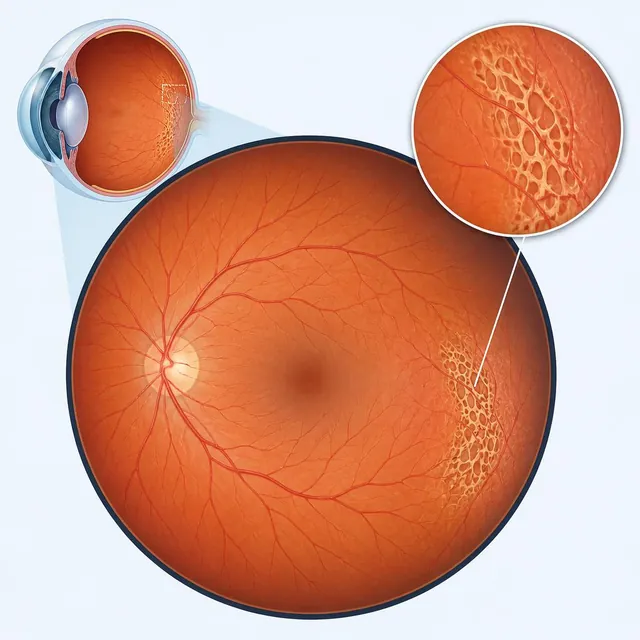
Lattice degeneration is a thinning of the peripheral retina, the outer edge that you do not use for reading. Under the eye doctor's lens it looks like a lattice of fine white lines, often with pigment or small holes. It is found in about 6 to 10 out of every 100 people, more commonly in short-sighted eyes, and most never have a problem. A small number develop a retinal tear or detachment, so the key question is who needs protective laser and who needs only watching.
Symptoms
Lattice degeneration usually causes no symptoms. It is typically found during a dilated eye test or before refractive surgery. Symptoms appear only if the thin area leads to a tear:
- New flashes of light
- A sudden increase in floaters
- A curtain or shadow in part of your vision
Red flags
New flashes, a shower of floaters, or a shadow across vision need a same-day dilated retina examination. See flashes and floaters .
Causes and risk factors
The exact cause is unknown. The peripheral retina is thinner in these areas and its attachment to the vitreous gel is stronger, so when the gel pulls away, the thin patch can tear.
- Short-sightedness (myopia), especially high myopia above -6 D, as the eye is stretched
- Family history of lattice, tears or detachment
- Detachment in the other eye
It is not caused by screen use, reading in dim light or by wearing glasses.
How it is diagnosed
It is diagnosed by a dilated retinal examination with indirect ophthalmoscopy and a lens at the slit lamp, with scleral indentation to view the far periphery. Fundus photographs or wide-field imaging document the area, and OCT is used when the macula needs a look. The doctor records whether there are holes, a tear or traction, the size and location of the lesion, and the state of the other eye.
Treatment: laser or watch?
Most lattice degeneration needs no treatment. The decision depends on the individual.
| Situation | Usual approach |
|---|---|
| Lattice without holes, no symptoms | Observe; yearly dilated check; learn warning signs |
| Lattice with a tear or symptomatic tear | Laser retinopexy (or cryopexy) soon |
| Lattice with a retinal detachment in the other eye, or strong family history of detachment | Prophylactic laser is often discussed |
| High myopia, planning refractive surgery, or cataract surgery | Individual decision after peripheral retina exam |
Laser retinopexy applies rows of small laser burns around the weak area. The burns create a scar that bonds the retina to the wall of the eye in a couple of weeks. It is an outpatient procedure under eye drops, taking minutes, with mild glare or ache afterwards. It reduces risk but does not give absolute protection, and it does not treat the vitreous pulling. A retinal detachment, if it happens, still needs retina surgery .
Lattice degeneration and LASIK
Having lattice does not automatically rule out vision correction. Generally, the peripheral retina is examined, any weak area that needs laser is treated, and surgery is considered after the retina has been secured. Refractive procedures are discussed individually.
What Vision Plus does
Prevention and living with it
Cost note
Dilated retina check: please call the desk for current consultation fees. Retinal laser: Rs 5,000 to 12,000 per sitting. See the eye treatment cost guide . CGHS and cashless insurance support, confirm panel at the desk
Frequently asked questions
What is lattice degeneration?
A thinning of the outer retina that looks like a net of fine lines through a dilated exam. It is found in a minority of people, mostly short-sighted ones, and usually causes no symptoms or damage.
Is lattice degeneration dangerous?
Usually not. Most lattice areas stay stable for life. The risk is that a thin spot may tear, leading to detachment, which is why high-risk eyes are watched or treated. The overall chance for any one patient is low.
Do I need laser for lattice degeneration?
Not always. Laser is advised when there is a tear, symptoms, or special risks such as a detachment in the other eye or a strong family history. Plain lattice is usually watched with yearly checks.
Can I have LASIK if I have lattice degeneration?
Often yes, after the peripheral retina is examined and any weak area needing laser is treated. Your surgeon will decide after a dilated exam. Refractive surgery does not cause lattice but should not be done without a retinal check.
What is the laser procedure and recovery like?
It takes a few minutes in clinic under numbing drops. You may see bright flashes and have a mild ache and glare afterward. Most return to routine within a day. The scar firms up over about two weeks.
Where can I get my peripheral retina checked in Noida?
Dr. Ajay Aurora sees patients at Vision Plus, Sector 51. Call or WhatsApp +91 8800313134 or book an appointment . Come with a companion; dilating drops blur near vision for several hours.
Book a retina check in Noida
A dilated retina examination takes about an hour and gives a clear answer. Call +91 8800313134 or book online . Sector 51: Mon to Sat 9:30 AM to 7:30 PM, Sun 10:00 AM to 4:00 PM. Gaur City-1: Mon to Sat 10:00 AM to 7:00 PM. More in our eye diseases library .
Medically reviewed by Dr. Ajay Aurora, November 2026