

Last updated: 7 November 2026
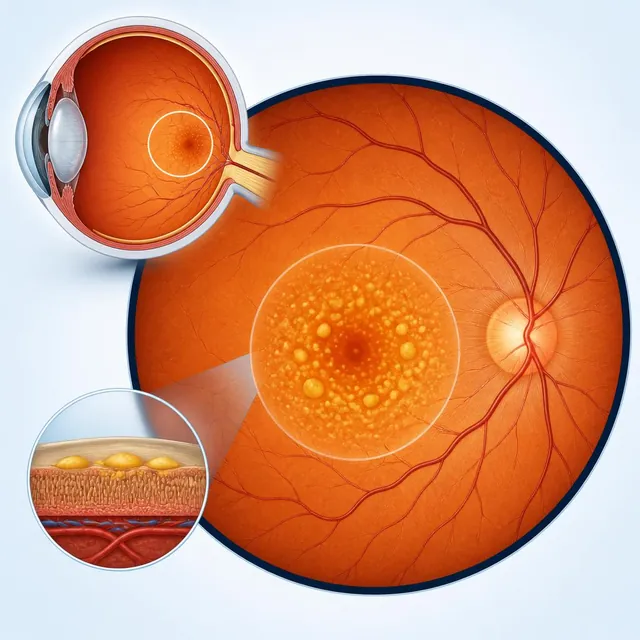
Age-related macular degeneration (AMD) is a disease of the macula, the small central part of the retina that gives sharp, detailed vision for reading, faces and driving. It never causes total blindness because side vision is spared, but it can take away central sight. There are two forms: dry (slow, common) and wet (faster, treatable with injections). Wet AMD treated early often keeps vision stable, so quick action matters.
Symptoms
- Blurred or dim central vision
- Straight lines that look wavy or bent (a door frame or a tile line)
- A grey, dark or empty patch in the middle of view
- Difficulty reading, recognising faces or seeing in low light
AMD is painless and usually affects one eye first. The other eye hides it, so test each eye separately.
Check yourself: Amsler grid
Hold a grid at reading distance with your reading glasses on, cover one eye and look at the central dot. If lines look wavy, broken or missing, or a patch is blank, see a retina specialist within days. A grid does not replace an eye exam.
When to see a doctor urgently
Sudden distortion or drop in central vision in someone with AMD may be a sign of wet AMD or bleeding under the retina. This is time-critical.
Dry and wet AMD
| Feature | Dry (atrophic) | Wet (neovascular) |
|---|---|---|
| Share of cases | About 85 to 90 in 100 | About 10 to 15 in 100 |
| What happens | Macular cells thin and waste; yellow deposits (drusen) | Abnormal vessels grow under macula and leak fluid or blood |
| Speed | Slow, over years | Can be weeks |
| Vision loss | Gradual | Sudden or rapid |
| Treatment | Vitamins (AREDS2) for intermediate and advanced stages; lifestyle; low vision aids | Anti-VEGF injections; sometimes PDT |
Causes and risk factors
Age is the main factor (over 50, risk rises with each decade). Others:
- Smoking, the strongest modifiable risk, roughly doubling the risk
- Family history and certain genes
- High blood pressure, cardiovascular disease and high cholesterol
How it is diagnosed
Treatment
Wet AMD. Anti-VEGF injections (bevacizumab, ranibizumab, aflibercept and biosimilars) block the growth signal. They are given into the eye in the operation theatre or minor procedure room under numbing drops, in an initial series of monthly doses and then at spacing set by OCT. Treatment is often long-term. Missed visits can lose the gains. Laser and PDT are used in selected cases.
Dry AMD. There is no medicine that restores lost macular cells. The AREDS2 formula (vitamins C and E, zinc, copper, lutein and zeaxanthin) lowers the chance of intermediate dry AMD turning advanced in studies, but it is for people with intermediate or advanced disease, not a general supplement, so ask first. Newer injections for geographic atrophy (advanced dry AMD) have been approved abroad; ask about availability and suitability in India.
Everyone. Stop smoking, eat leafy greens and fish, control blood pressure, wear sunglasses, and check each eye weekly with an Amsler grid. If central sight is reduced, see our low vision aids for magnifiers and lighting. For retinal complications see retina surgery .
What Vision Plus does
Dr. Ajay Aurora , a medical and surgical vitreoretinal specialist with experience in intravitreal injections, sees AMD at Sector 51 (Kisan Tower, near Sector 51 metro). Assessment includes OCT, fundus imaging and, when needed, angiography, under our retina, uvea and vitreous service . Patients from Noida Extension can book through the Gaur City-1 desk.
Cost note
Indicatively Rs 12,000 to 35,000 per anti-VEGF injection depending on the molecule; OCT Rs 1,500 to 4,500. Repeated injections add up, so ask for a plan and biosimilar options. See the eye treatment cost guide . CGHS and cashless insurance support, confirm panel at the desk
Frequently asked questions
What is macular degeneration?
It is a loss of central vision from damage to the macula, usually after age 50. The dry form is slow; the wet form, due to leaking vessels, is faster. Side vision remains, so you do not go completely blind.
Is macular degeneration the same as cataract?
No. Cataract is clouding of the lens in the front of the eye and is corrected by surgery. AMD is a disease of the retina at the back. They often occur together, and cataract surgery will not fix AMD.
Can macular degeneration be cured or stopped?
It cannot be cured. Wet AMD can often be stabilised with regular injections, sometimes with some visual gain. Dry AMD progresses slowly; vitamins in selected patients, a healthy lifestyle and no smoking help slow it.
Do vitamins help macular degeneration?
The AREDS2 combination helps people with intermediate or advanced dry AMD, not people with healthy eyes or early changes. Ask your retina specialist before starting, particularly if you smoke or take other medicines.
What happens during an anti-VEGF injection visit?
The eye is numbed and cleaned, and a tiny needle delivers the medicine into the jelly of the eye, in a couple of minutes. You go home the same day. Risks, including infection and raised pressure, are uncommon and explained beforehand.
How much does AMD treatment cost and where can I get it in Noida?
Indicatively Rs 12,000 to 35,000 per injection, depending on the drug; final quote follows examination. Book with Dr. Ajay Aurora at Vision Plus, Sector 51. Call +91 8800313134 or book an appointment .
Book a macula check in Noida
Do not wait if lines look bent. Call or WhatsApp +91 8800313134, or book online . Sector 51: Mon to Sat 9:30 AM to 7:30 PM, Sun 10:00 AM to 4:00 PM. Gaur City-1: Mon to Sat 10:00 AM to 7:00 PM. More in our eye diseases library .
Medically reviewed by Dr. Ajay Aurora, November 2026