
Last updated: 7 November 2026
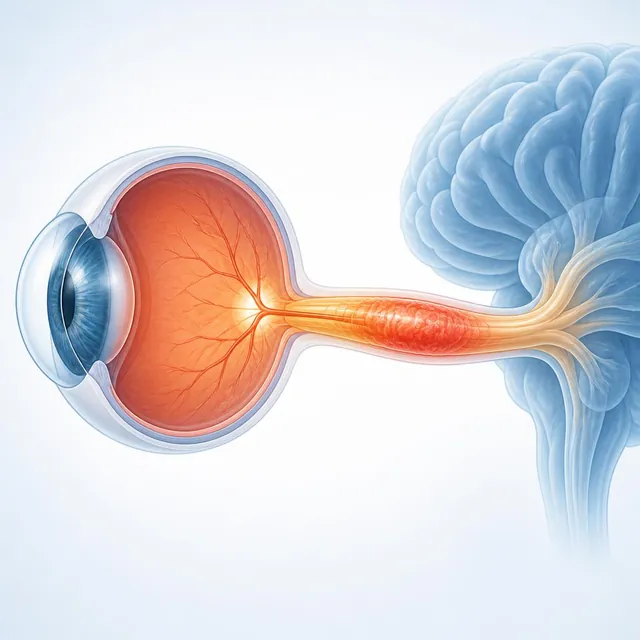
Optic neuritis is inflammation of the optic nerve, the cable that carries images from the eye to the brain. It typically causes blurred or dim vision in one eye over hours to days, with pain when you move the eye. Most people recover a good part of their vision over weeks to months, but the cause must be looked for, so an early eye examination matters.
Symptoms of optic neuritis
Classic optic neuritis shows up as three things together: reduced vision in one eye, pain on eye movement, and washed-out colours. It is commonest in adults aged 20 to 45 and more often in women.
- Vision turns blurred, foggy or has a dark spot in the centre, worsening over a few days.
- A dull ache behind the eye, worse when you look sideways or up.
- Red looks pale or orange-brown compared with the other eye (colour desaturation).
Red flags and urgency
Do not wait if you have sudden loss of vision in one or both eyes, loss of vision in both eyes together, a history of weakness, numbness or trouble walking, severe vomiting or hiccups with visual loss, or no improvement after 4 weeks. Aim for an eye examination within one to two days.
Causes and risk factors
The most common cause in young adults is an immune attack on the nerve's covering, often linked to multiple sclerosis (MS). Other causes include neuromyelitis optica spectrum disorder (NMOSD) and MOG antibody disease, which behave differently and need different treatment.
How optic neuritis is diagnosed
Diagnosis starts with a careful eye examination and a few simple tests. A standard eye hospital can do most of it in one visit.
- Visual acuity and colour vision.
- Pupil test for a relative afferent pupillary defect (the affected pupil reacts weakly to light).
- Dilated fundus examination: the optic disc may look swollen, or normal if the inflammation is behind the eye.
- Visual field test to map blind spots.
- OCT of the optic nerve and retinal nerve fibre layer.
An MRI of the brain and orbits with contrast, and sometimes blood tests for NMOSD, MOG and infection, are then arranged through a neurologist or imaging centre. Your eye team coordinates the results.
Treatment options
Many mild cases recover on their own, but treatment is guided by severity and by the cause.
- High-dose intravenous steroids: Usually methylprednisolone for about three days, sometimes followed by tablets. They speed recovery of vision but do not change the final outcome much in typical cases. Admission and monitoring are needed. Oral steroids alone at low dose are not advised.
- Treating the cause: MS-related, NMOSD, MOGAD or infective neuritis each need specific management with a neurologist.
What Vision Plus does for optic neuritis
Vision Plus offers eye OPD, OCT and diagnostic services at Sector 51, with the neuro-ophthalmology service handling nerve and vision-pathway problems. Brain MRI and neurology input are coordinated through referral.
Cost note
Consultation, visual field and OCT are usually the main eye costs. An indicative range is OCT Rs 1,500 to 4,500 and visual field Rs 1,500 to 3,000, with consultation fees available from the desk. MRI and hospital steroid therapy are billed separately. Final quote after examination. See eye treatment cost in Noida . Prices reviewed: November 2026.
Living with it
Frequently asked questions
What is optic neuritis?
It is swelling and inflammation of the optic nerve that links the eye to the brain. It usually affects one eye, causes blurred vision, pain on eye movement and dull colours, and often improves over weeks. Cause and risk of recurrence still need checking.
Does optic neuritis mean I have multiple sclerosis?
Not always. Optic neuritis can be the first sign of MS, so an MRI brain scan is advised to judge the risk. Other causes such as NMOSD, MOGAD, infection or no clear cause are also possible. Your neurologist and eye doctor explain what the scan shows.
Will my vision come back?
In most people vision recovers substantially over four to twelve weeks, though some dullness of colour or contrast can stay. Recovery is less complete in NMOSD and severe attacks. Early assessment helps decide whether faster treatment is needed.
Do I need steroid injections?
Steroids given by drip for about three days can speed recovery, especially when vision is poor, but they do not change the final result in typical cases. They are not given casually, as they have side effects. The decision depends on your examination and MRI.
What tests will I need and what do they cost?
Expect vision, colour, pupil and field tests, OCT and a dilated exam, then MRI by referral. Eye tests are indicatively Rs 600 to 1,500 each. MRI and hospital steroid costs are separate. The desk can estimate after your first visit.
Where can I be seen in Noida?
Visit Vision Plus at Sector 51, near the metro, or the Gaur City-1 centre. Call or WhatsApp +91 8800313134 and say it is a sudden vision problem so you are slotted early. You can also use the appointment page .
Book an eye examination
Call or WhatsApp +91 8800313134, or book at /appointment . Surgery and procedure consultation: +91 9717417417.
Sector 51: Kisan Tower, Capt Shashikant Sharma Marg (Mon to Sat 9:30 AM to 7:30 PM, Sun 10:00 AM to 4:00 PM). Gaur City-1: Aarza Square-2, Greater Noida West (Mon to Sat 10:00 AM to 7:00 PM, Sun closed).
Last reviewed: November 2026