
Last updated: 7 November 2026
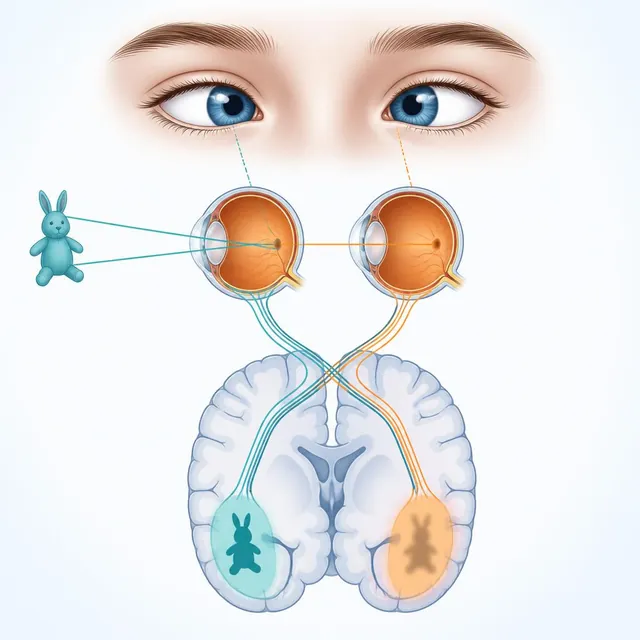
Squint (strabismus) means the two eyes do not point at the same object together; one drifts in, out, up or down. Lazy eye (amblyopia) is reduced vision in an eye that the brain has learned to ignore, usually because of squint or uneven glasses power. Squint is not something children simply outgrow. Early treatment with glasses, patching or surgery can protect sight and appearance.
Squint (tirchi nazar): symptoms
The main sign is eyes that are not lined up, which may be constant or only when tired or looking far. Parents often see it in photos.
- One eye turns inward (esotropia), outward (exotropia), up or down.
- Closing one eye in bright light.
- Double vision, mostly in adults.
Red flags
New squint in an older child or adult with double vision, headache, drooping lid or a change in the pupil needs urgent examination, as it can reflect a nerve or neurological problem. A white pupil in a child who has a squint also needs an immediate check. After about 4 months of age, any persistent eye turn is not normal.
Causes and risk factors
Common causes are uncorrected glasses power (especially hypermetropia), family history and weak eye muscle control.
Amblyopia occurs when one eye sees blurred images during the early years of visual development, from squint, a big difference in power between the eyes, or a blocked visual axis.
How squint and lazy eye are diagnosed
An orthoptic and ophthalmic examination finds the angle of the squint and the vision in each eye. Tests include:
- Vision with age-appropriate charts.
- Corneal light reflex and cover tests, with prism measurement of the deviation.
- Eye movement tests in all directions.
- Cycloplegic refraction (glasses power under drops, since children's focusing hides it).
- Dilated retina and eye health examination to exclude other causes.
Treatment options
The usual order is glasses, then patching for lazy eye, then surgery if the eyes remain misaligned.
| Option | Role |
|---|---|
| Glasses | Corrects focusing; may straighten some inward squints fully |
| Patching or atropine drops | Treats lazy eye by training the weaker eye; time-bound, requires cooperation |
| Squint surgery | Moves or shortens eye muscles to realign the eyes |
Lazy eye treatment works best before about 7 to 8 years of age, though some improvement is possible in older children and teens; do not assume it is too late. Surgery is performed under general anaesthesia in children, usually day-care, with the eye muscles repositioned without removing the eye. Adults can often have it under local anaesthesia. Risks include over- or under-correction, double vision, infection and the need for a second operation. Surgery improves alignment; it does not on its own treat lazy eye, and glasses or patching continue.
What Vision Plus does for squint
Vision Plus has paediatric-friendly zones at Sector 51 and Gaur City-1. All surgery, including squint surgery, is performed in modular operation theatres at Sector 51. Dr. Ritu Aurora lists paediatric ophthalmology and complicated and paediatric cataract among her interests and sees children and adults with squint. See Dr. Ritu Aurora and the squint and paediatric ophthalmology service .
Squint surgery cost
Squint surgery is indicatively Rs 30,000 for one muscle up to Rs 45,000 for three muscles, and up to Rs 60,000 for adult or complex cases. Number of muscles, anaesthesia, revision surgery and hospital stay change the price. Final quote after examination. CGHS and cashless insurance support, confirm panel at the desk. See eye treatment cost in Noida . Prices reviewed: November 2026.
Living with it
Use glasses and patch as advised, even if the child resists; reward charts help. Keep reviewing every few months through childhood, because amblyopia can return. See also paediatric eye diseases , refractive error , and the eye diseases hub .
Frequently asked questions
What is a squint?
It is a misalignment of the eyes, where one eye turns in, out, up or down while the other looks straight. It may be constant or intermittent. In children it can lead to lazy eye, so it needs early assessment.
Will squint go away on its own?
Usually not. Newborns may have crossed-looking eyes up to about 4 months, but a persistent turn needs examination. Some squint improves with glasses, but many need patching or surgery. Waiting risks permanent weak vision in one eye.
What age is too late to treat lazy eye?
Treatment works best before 7 to 8 years, but older children and some teens still improve with patching and glasses. Adults rarely gain much vision, though squint alignment can still be treated. Early check is the best option.
Is squint surgery safe?
It is a commonly performed operation, usually day-care, under general anaesthesia in children. Risks include under- or over-correction, double vision and infection. A repeat operation is sometimes needed. Your surgeon will discuss risks specific to your child.
How much does squint surgery cost in Noida?
Indicatively Rs 30,000 to 45,000 depending on the number of muscles, and up to Rs 60,000 for adult or complex cases. A fixed quote is given after examination. Ask about CGHS and cashless insurance support.
Where can I get a child's squint checked in Noida?
At Vision Plus Sector 51 (near the metro) or Gaur City-1 for Noida Extension families. Call or WhatsApp +91 8800313134, or use the appointment page . Bring any old prescriptions.
Book a squint assessment
Call or WhatsApp +91 8800313134, or book at /appointment . Surgery consultation: +91 9717417417.
Sector 51: Kisan Tower, Capt Shashikant Sharma Marg (Mon to Sat 9:30 AM to 7:30 PM, Sun 10:00 AM to 4:00 PM). Gaur City-1: Aarza Square-2, Greater Noida West (Mon to Sat 10:00 AM to 7:00 PM, Sun closed).
Medically reviewed by Dr. Ritu Aurora, November 2026