
Last updated: 7 November 2026
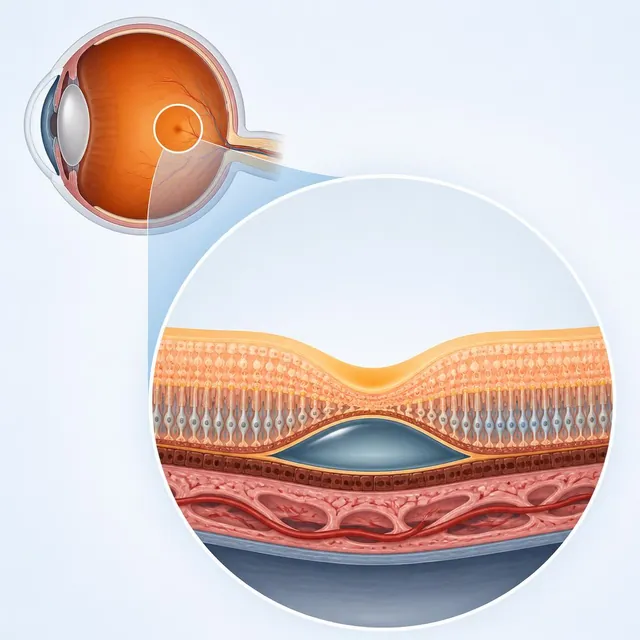
Central serous retinopathy (CSR), also called central serous chorioretinopathy, is a condition in which fluid collects under the macula, the small central part of the retina responsible for sharp vision. It most often affects men aged 25 to 50, usually in one eye. In most people the fluid clears by itself in about three to four months, so treatment is often watchful waiting first.
Symptoms
- A blurred or dim patch in the centre of vision
- Straight lines that look bent or wavy (metamorphopsia)
- Objects looking smaller in the affected eye (micropsia)
There is no pain or redness. Because the other eye compensates, many people ignore it for weeks.
When to see a doctor
Any new central blur or distortion should be checked within a few days. Go the same day if you also see flashes, a rain of floaters, or a curtain, since those suggest retinal tear or detachment, a different problem.
Causes and risk factors
The retinal pigment layer and the blood-rich choroid beneath it become leaky, and fluid seeps under the retina. The reason is not fully known, but these are well-recognised triggers:
- Corticosteroids in any form. Tablets, injections, inhalers, nasal sprays, skin creams and some unlabelled herbal or "tonic" products. Never stop a prescribed steroid yourself; speak to the prescribing doctor.
- Emotional or physical stress, poor sleep and a driven (type A) personality
- Male sex, age 25 to 50
- Pregnancy
How it is diagnosed
The key test is OCT (optical coherence tomography), a painless scan that shows a cross-section of the macula and the fluid pocket. A dilated retinal exam and fundus photograph support it. Fluorescein angiography (a dye test that maps leaking spots) or OCT angiography may be done if treatment with laser is being planned, or if the diagnosis is not clear. Wet macular degeneration and macular swelling can mimic CSR, so correct diagnosis matters. See macular degeneration .
Treatment: what is done and when
| Stage | Approach | Notes |
|---|---|---|
| First 3 to 4 months | Observation with OCT follow-up | Fluid clears on its own in most; stop or reduce steroids with prescriber's advice, manage stress and sleep |
| Fluid persists beyond about 3 to 4 months, or vision falls | Half-dose photodynamic therapy (PDT) | Light-activated dye treatment; targets the leaking choroid |
| Leak well away from the centre | Focal laser photocoagulation | Seals the leak; not used close to the fovea |
| Selected cases | Subthreshold or micropulse laser | Gentle laser that avoids retinal burns; availability varies |
| Chronic or recurrent | Anti-VEGF if abnormal vessels (choroidal neovascularisation) appear | Not a routine treatment for ordinary CSR |
What Vision Plus does
Dr. Ajay Aurora is our medical and surgical vitreoretinal specialist and sees macular conditions at the Sector 51 centre (near Sector 51 metro). The visit usually includes dilated examination, OCT and fundus imaging, with a plan for follow-up scans. Retinal laser sittings are available under our retina, uvea and vitreous service . Surgery is not part of CSR care.
Prevention and living with it
Cost note
Follow-up involves consultation and OCT (indicative Rs 1,500 to 4,500). Retinal laser is indicatively Rs 5,000 to 12,000 per sitting; PDT costs differ, so ask for a written estimate. See the eye treatment cost guide . CGHS and cashless insurance support, confirm panel at the desk
Frequently asked questions
What is central serous retinopathy?
It is a build-up of fluid under the macula, the part of the retina that gives sharp central vision. It causes blurred or distorted vision, usually in one eye of a working-age adult. The fluid often drains by itself in a few months.
Will I lose my vision permanently?
Most people regain good vision, though some notice mild dimness or colour change. Repeated or long-standing fluid can damage the photoreceptors and leave permanent loss, which is why persistent cases are treated rather than left alone.
Does stress cause central serous retinopathy?
Stress hormones, such as cortisol, are believed to play a role, and the condition is common in stressful periods. It is also strongly tied to steroid medicines. Stress alone is not the whole story, so look at medicines too.
Do I need laser or injections for CSR?
Not at first. If fluid is still there after about three to four months, or vision keeps dropping, treatments such as half-dose PDT or focal laser are considered. Anti-VEGF injections are used only if abnormal vessels are found.
How long does recovery take?
Typically two to four months for the fluid to clear, with vision continuing to improve for a few more weeks. Distortion can linger. Regular OCT checks tell us whether you are healing as expected.
Can CSR come back, and where can I be treated in Noida?
It recurs in roughly a third of patients, so follow-up matters. Dr. Ajay Aurora treats CSR at Vision Plus, Sector 51. Call +91 8800313134 or book an appointment .
Book a retina check-up
A central blur is worth a scan, not a guess. Call or WhatsApp +91 8800313134, or book online . Sector 51: Mon to Sat 9:30 AM to 7:30 PM, Sun 10:00 AM to 4:00 PM. See more in our eye diseases library .
Medically reviewed by Dr. Ajay Aurora, November 2026