

Last updated: 7 November 2026
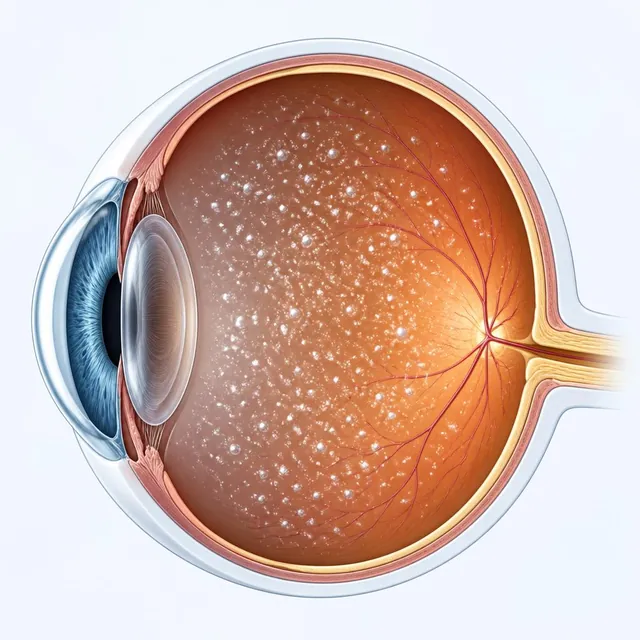
Asteroid hyalosis is a harmless-in-most-cases condition in which tiny white-yellow balls of calcium and fat float in the vitreous, the clear jelly that fills the back of the eye. It usually affects one eye in people over 50 and often causes surprisingly few symptoms. Most people find out only when an eye doctor sees a "starry night" through the pupil.
Symptoms: what you may or may not notice
Many patients notice nothing at all. The spheres are attached to the vitreous framework, so they move with it and settle back when the eye stops, unlike ordinary floaters that drift and swirl. The doctor often sees far more than you do.
When symptoms occur they are usually mild: a few specks or a haze, glare in bright light, or slightly dull vision when the spheres are dense. Sharp central vision is usually normal.
Red flags: do not put these down to asteroid hyalosis
A sudden shower of new floaters, flashing lights, a curtain or shadow across vision, or a sudden drop in sight is not asteroid hyalosis. It can mean a retinal tear or detachment and needs a same-day retina check. Read about flashes and floaters .
Causes and risk factors
The exact cause is not known. The spheres are made of calcium soaps (calcium and phospholipids). Known associations are age (it is uncommon below 50), being male, and one-eyed involvement in about three out of four people. Links with diabetes, high blood pressure and raised cholesterol have been reported, but studies disagree, so it is not a reason to worry about a blood test result alone. It is not caused by diet, screens or calcium tablets.
Asteroid hyalosis or ordinary floaters?
| Feature | Asteroid hyalosis | Common floaters |
|---|---|---|
| What they are | Calcium-fat spheres in vitreous | Collagen clumps or vitreous strands |
| Movement | Move slightly, return to place | Drift and swirl freely |
| Usual age | 50+ | 40+, or younger in short-sighted people |
| Usual side | One eye | Often both |
| Usual symptom | Little or none | Moving specks or cobwebs |
How it is diagnosed
Treatment: honest options
Most people need no treatment, only a regular check-up.
- Observation: the standard plan. Review once a year, or sooner if symptoms change.
- Medicines: none dissolve the spheres. Calcium restriction, drops and supplements do not help.
- Surgery: vitrectomy (removing the vitreous gel) is reserved for people whose vision is reduced enough to disturb daily life, or whose retinal disease cannot be treated through the spheres. It carries the usual vitrectomy risks, such as cataract and, rarely, retinal detachment, so it is advised only after discussion.
What Vision Plus does
Dr. Ajay Aurora , our medical and surgical vitreoretinal specialist, examines patients with vitreous opacities at the Sector 51 centre (near Sector 51 metro) with dilated retinal evaluation, OCT and fundus imaging. Our retina, uvea and vitreous service also covers diabetic retinopathy and lattice degeneration , which need to be excluded because the spheres can hide them.
Living with it
Cost note
Evaluation is a standard dilated check-up (please call the desk for current consultation fees) plus OCT (indicatively Rs 1,500 to 4,500) if needed. Vitrectomy, if ever required, is indicatively Rs 50,000 to 1,20,000+; see the eye treatment cost guide .
Frequently asked questions
What is asteroid hyalosis?
It is a condition where tiny calcium-containing spheres float suspended in the vitreous gel inside the eye. It is mostly seen after 50, in one eye. The spheres are visible to the doctor as bright dots, but the patient may see little or nothing.
Is asteroid hyalosis dangerous?
In most people it is not. It does not damage the retina or cause blindness on its own, and it does not raise the risk of retinal detachment. The risk is indirect: the spheres may make other retinal disease harder to see, so regular dilated checks matter.
Does asteroid hyalosis need treatment?
Usually not. If vision is good and the retina is healthy, you only need follow-up. Surgery is considered when the spheres reduce sight enough to affect daily life, or when the retina cannot be examined or treated properly through them.
Is asteroid hyalosis the same as floaters?
No. Floaters are collagen clumps that drift, and they follow a posterior vitreous detachment. Asteroid hyalosis spheres are firmly held and move little. They can co-exist, so a new shower of floaters still needs an urgent exam.
Is it linked to diabetes or cholesterol?
Some studies have suggested a link, others have not found it. Diabetes is more important for a different reason: diabetic retinopathy can hide behind the spheres. If you are diabetic, an annual dilated exam with OCT is sensible.
Where can I get my retina checked in Noida?
Book a dilated retina check with Dr. Ajay Aurora at Vision Plus, Sector 51 (Kisan Tower). Call or WhatsApp +91 8800313134 or book an appointment . Bring any earlier scans and your diabetes records.
Book a retina check-up
If you were told you have "white specks" in your eye, a one-time retina evaluation gives peace of mind. Call +91 8800313134 or book online . Sector 51 centre: Mon to Sat 9:30 AM to 7:30 PM, Sun 10:00 AM to 4:00 PM. See more in our eye diseases library .
Medically reviewed by Dr. Ajay Aurora, November 2026