

Last updated: 7 November 2026
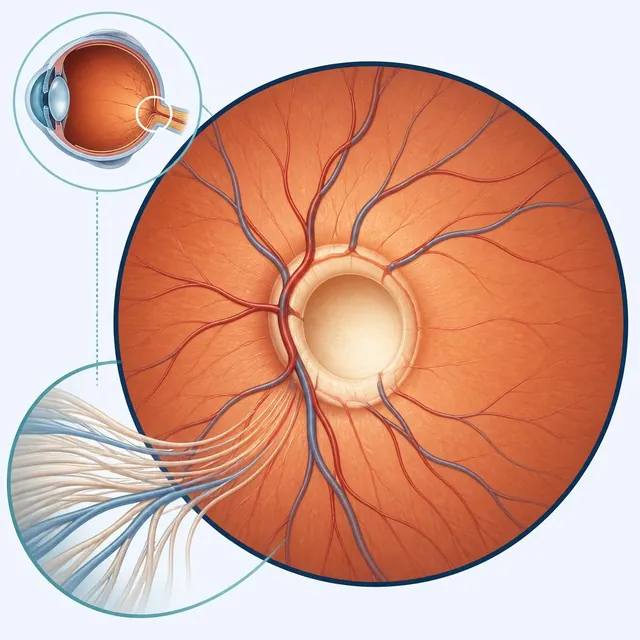
Glaucoma (kala motia) is a group of eye diseases in which the optic nerve, the cable carrying images from the eye to the brain, is slowly damaged, usually when eye pressure is too high for that nerve. The common form has no symptoms until sight is already lost, which is why it is called the silent thief of sight. Lost vision cannot be restored, but treatment can stop it from getting worse.
Symptoms
How glaucoma feels depends on the type.
| Type | How it develops | What you notice |
|---|---|---|
| Primary open-angle (commonest) | Slowly over years, with drainage clogged | Nothing at first. Then patchy blind spots, usually at the side; you bump into things; late central loss ("tunnel vision") |
| Angle-closure, chronic | Slowly | Often silent; occasional halos or brow ache |
| Angle-closure, acute | Within hours | Severe eye pain, red eye, headache, nausea, vomiting, blurred vision, rainbow halos around lights |
Red flag: acute attack
Sudden severe eye pain with headache, nausea, haloes and a red eye is an emergency. Seek an eye doctor immediately. Laser or medicines in the first hours can save sight. Do not wait for morning.
Causes and risk factors
Glaucoma damage is linked to pressure inside the eye (intraocular pressure) and, in some people, poor blood supply to the nerve. Aqueous fluid is made constantly and drains through the angle of the eye. When drainage is blocked or narrowed, pressure rises.
Higher risk if you:
- Are above 40 (angle-closure is more common in Asians, women, and long-sighted people)
- Have a parent, brother or sister with glaucoma
- Are short-sighted (open-angle) or long-sighted (angle-closure)
- Use steroids as drops, tablets, inhalers or creams for long periods
- Have thin corneas or large optic discs
Cataract and glaucoma are different diseases, and glaucoma vision loss does not improve with cataract surgery, though an advanced cataract can close the angle in some eyes.
How it is diagnosed
No single test is enough. A glaucoma work-up at a standard eye hospital includes:
- Tonometry: eye pressure measurement
- Gonioscopy: looking at the drainage angle with a special lens
- Optic disc examination and OCT of the nerve fibre layer
- Visual field test (perimetry): maps blind spots
- Pachymetry: corneal thickness, which affects pressure readings
Because pressure varies, measurements are repeated over visits. Early cases are tracked for change before treatment is decided.
Where treatment fits
Glaucoma is controlled, not cured. Options include pressure-lowering eye drops, laser (such as SLT for open-angle or iridotomy for narrow angles) and surgery, including trabeculectomy, drainage devices and micro-invasive glaucoma surgery (MIGS), chosen by the stage, type and your health. Read details on our glaucoma treatment and surgery page . Cost ranges are in the eye treatment cost guide .
What Vision Plus does
Dr. Ritu Aurora has an interest in glaucoma surgery, both conventional and MIGS. Glaucoma checks including pressure, angle, OCT and visual fields are available at our Sector 51 centre (Kisan Tower, near Sector 51 metro). Patients from Noida Extension and Greater Noida West can start at the Gaur City-1 centre; please ask the desk which tests are available there. Bring previous disc scans and field reports.
Prevention and living with it
You cannot prevent glaucoma, but you can prevent blindness from it:
- Get a complete dilated eye check at 40, and every one to two years if you are in a risk group
- Check siblings and children if a close relative has glaucoma
- Never use steroid drops without supervision
- Keep your appointments and field tests; progression is measured over time
Frequently asked questions
What is glaucoma?
It is a group of eye diseases that damage the optic nerve, often with high eye pressure. It starts at the edge of vision and spreads inwards. Damage is permanent, but timely treatment can protect remaining vision.
Can I have glaucoma without any symptoms?
Yes, and it is the usual story. Open-angle glaucoma causes no pain and no blurring until late. Your central vision stays sharp for years, which hides the problem. Only an eye examination detects it early.
Who should be tested for glaucoma and when?
Everyone should have a complete dilated check around age 40. Start earlier and test more often if you have a family history, diabetes, high myopia, steroid use, an eye injury or narrow angles. Children of glaucoma patients should be checked.
Is glaucoma curable and will I go blind?
It cannot be cured and lost sight does not return, but most people who start treatment on time keep useful vision for life. Blindness mostly occurs when the disease is found late or treatment is stopped.
Is glaucoma hereditary?
It often runs in families. Having a parent or sibling with glaucoma raises your risk several-fold. That does not mean you will definitely get it, only that you should have regular tests.
Where can I get a glaucoma test in Noida?
Book a glaucoma assessment with Dr. Ritu Aurora at Vision Plus, Sector 51 (Kisan Tower). Call or WhatsApp +91 8800313134, or book an appointment . Allow about two hours for dilated tests.
Book a glaucoma check in Noida
Eye pressure and the nerve can be checked in one visit. Call +91 8800313134 or book online . Sector 51: Mon to Sat 9:30 AM to 7:30 PM, Sun 10:00 AM to 4:00 PM. Gaur City-1: Mon to Sat 10:00 AM to 7:00 PM. More in our eye diseases library .
Medically reviewed by Dr. Ritu Aurora, November 2026