

Last updated: 7 November 2026
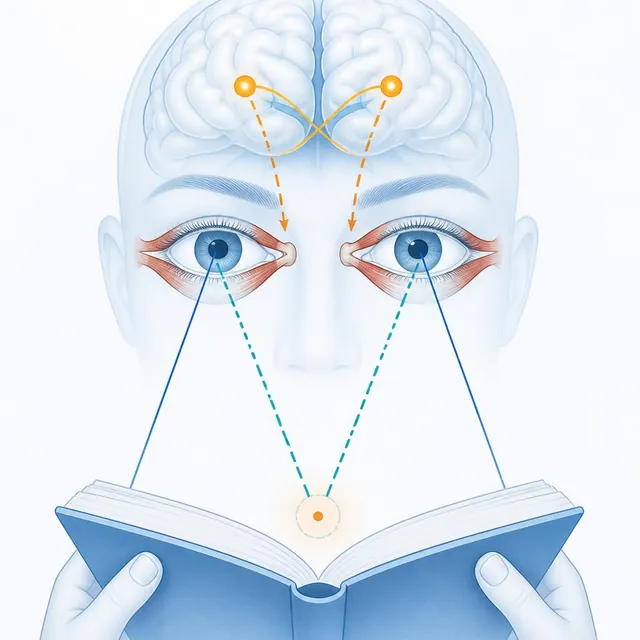
Convergence insufficiency is a binocular vision problem in which the two eyes do not turn inward together properly when looking at something close, such as a book or phone. The eyes may look straight, and vision charts may be normal, yet reading causes strain, headaches or double vision. It is common in school children and young adults and is treatable.
Symptoms
- Eye strain, tiredness or aching after reading, phone or computer use
- Headache around the brow after near work
- Blurred or double vision when reading
- Words that seem to move, float or jump
- Losing your place or re-reading lines
- Sleepiness while reading, or avoiding reading
An older child may not describe it. Signs a parent can notice: rubbing eyes, short attention for homework, and an eye drifting outward when reading.
Red flags
New double vision at any distance, a drooping lid, headache with vomiting, or any onset after a head injury needs urgent medical review. These suggest a nerve or brain cause rather than simple convergence insufficiency. See neuro-ophthalmology .
Causes and risk factors
Often there is no clear cause. Known contributors include:
- Prolonged near work and screen time (they do not cause the condition on their own, but they reveal it)
- Uncorrected long-sightedness or poor accommodation (focusing power)
- Concussion or head injury
- Thyroid eye disease and other neuromuscular conditions
It occurs in a few percent of children; reported rates in studies vary widely.
How it is diagnosed
The diagnosis rests on a careful orthoptic and eye examination in the OPD:
- Near point of convergence (NPC): how close a target can come to your nose before one eye drifts out or you see double. Beyond about 6 to 7 cm is regarded as reduced.
- Cover test at distance and near to measure the outward drift (exophoria)
- Fusional vergence ranges with prisms
- Cycloplegic refraction (glass power after dilating drops) to detect hidden long-sightedness
- Dilated eye examination to exclude other causes
It is not detected by a vision-chart-only screening, which is why many children are missed.
Treatment
Correct the glasses first. Even small amounts of hypermetropia (long-sightedness) or astigmatism, when corrected, can lessen symptoms. Reading glasses or a prism may help some adults.
Vergence therapy. A large US trial (CITT) found that office-based vergence and accommodative therapy with reinforcement at home, about 12 weeks, worked better than home pencil push-ups alone or placebo therapy. Gains hold well in most patients.
Home exercises. A basic routine:
- Hold a pencil or small target at arm's length, in line with your nose.
- Focus on a letter on it.
- Slowly bring it toward your nose while keeping a single image.
- Stop when you see double, push it back a little and repeat for 5 to 10 minutes, 5 days a week.
Pencil push-ups alone have weaker evidence, so use them as a bridge, not as a stand-alone cure.
Surgery is very rarely needed, only in resistant cases after full therapy.
What Vision Plus does
Dr. Ritu Aurora handles paediatric ophthalmology and sees children and adults with eye strain at Sector 51 and Gaur City-1. We check glass power, binocular function and ocular health, and exclude other causes of strain . Please ask the desk whether vergence (orthoptic) therapy sessions are suitable for you. See our squint and paediatric eye care and dry eye pages if symptoms overlap.
Frequently asked questions
What is convergence insufficiency?
It is a condition where the eyes struggle to turn inward together for near tasks. Reading becomes tiring, with headache, blur or double vision. Eyesight on a chart is usually normal, which is why it is missed.
Is convergence insufficiency the same as squint or lazy eye?
No. Squint is a visible misalignment present most of the time, and lazy eye (amblyopia) is reduced vision from childhood. In convergence insufficiency the eyes look straight at distance and drift only at near work. It can co-exist with them.
Do glasses fix convergence insufficiency?
Plain glasses help only if you also have hidden long-sightedness or astigmatism. Many patients also need vergence therapy. Special prism glasses help some adults. Your doctor decides after measuring your eyes.
Do eye exercises really work for convergence insufficiency?
Yes, for most people. Trials show a good response to a structured programme of supervised office therapy with home practice. Simple pencil push-ups alone have weaker evidence. Consistency over about 12 weeks matters most.
Will my child outgrow it?
It does not reliably go away without help, and symptoms often get worse as school workload rises. Treatment works well and benefits are usually lasting. Early assessment helps learning and comfort.
Where can I get tested for convergence insufficiency in Noida?
At Vision Plus, with Dr. Ritu Aurora at Sector 51 (Kisan Tower) or Gaur City-1. Call or WhatsApp +91 8800313134 or book an appointment . Bring any old glasses and your child's school reading complaints.
Book an eye check-up in Noida
Tired eyes while reading deserve measurement, not guesswork. Call or WhatsApp +91 8800313134, or book online . Sector 51: Mon to Sat 9:30 AM to 7:30 PM, Sun 10:00 AM to 4:00 PM. Gaur City-1: Mon to Sat 10:00 AM to 7:00 PM. More in our eye diseases library .
Medically reviewed by Dr. Ritu Aurora, November 2026