

Last updated: 7 November 2026
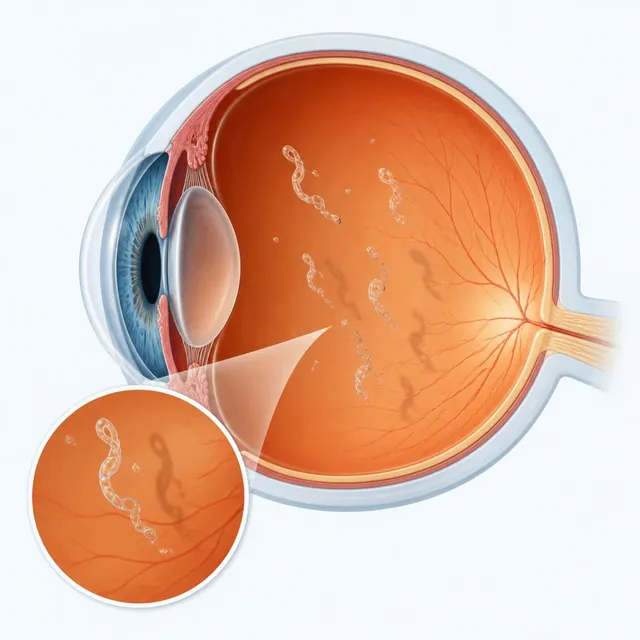
Floaters are small specks, threads or cobwebs that drift across your vision; flashes are brief streaks of light, often seen at the edge. Most are harmless and come from natural ageing of the vitreous, the jelly inside the eye. But a sudden new shower of floaters, new flashes or a shadow can mean a retinal tear, which needs a dilated check within 24 hours.
When is it an emergency?
| Harmless pattern | Same-day pattern (see a retina doctor now) |
|---|---|
| Few floaters present for months or years, unchanged | Sudden new floaters, or a sudden increase |
| Specks that drift away when you move your eyes | A shower of dots like "soot" or "flying insects" |
| Seen best against a bright wall or sky | New flashes of light, especially in dim light or on eye movement |
Do not wait to see if it settles. Early treatment of a tear can prevent a detachment, which is much harder to fix. If you are in Noida, call Vision Plus on +91 8800313134 during clinic hours; the desk will give you the earliest available slot.
What causes floaters and flashes
The vitreous is a clear gel attached to the retina. With age (most commonly after 50, earlier in short-sighted people) it shrinks and pulls away in a process called posterior vitreous detachment (PVD). The clumps of collagen cast shadows (floaters). When the gel tugs on the retina, the retina "sees" flashes.
Most PVDs are harmless. In a small proportion of people with new symptoms (often quoted at about 1 in 10, with studies giving a range) the gel tears the retina as it pulls away. Fluid can then pass through the tear and lift the retina off the wall of the eye. That is retinal detachment.
Other causes include:
- High short-sightedness, with lattice degeneration or thin peripheral retina
- Bleeding in the eye, as in diabetic retinopathy
- Migraine: flashes of light that last 15 to 30 minutes in both eyes, often zig-zag shaped, and not tied to eye movement
Asteroid hyalosis is a different cause of vitreous specks.
How it is diagnosed
The diagnosis is made by a dilated retinal examination, ideally with indirect ophthalmoscopy and a careful look at the far retinal edges, sometimes with gentle pressure on the eyelid (scleral indentation). OCT can confirm PVD and check the macula. B-scan ultrasound is used when blood or cataract blocks the view. A normal check does not rule out a later tear, so you are told which symptoms mean a return visit. A second check is usually advised after 4 to 6 weeks.
Treatment
Harmless floaters need no treatment. Over weeks to months the brain learns to ignore them and they settle lower in the eye. No drops, vitamins or exercises remove them.
Retinal tear. If a tear is found, it is treated in the clinic:
- Laser retinopexy (laser spots around the tear to seal it) or cryopexy (freezing)
- Usually a short outpatient procedure; the eye is numbed with drops
- Avoid heavy exercise and straining for a short period
Retinal detachment needs surgery: vitrectomy, scleral buckle or pneumatic retinopexy, depending on the case. See retina surgery .
For severe, long-standing floaters that spoil vision, options include YAG vitreolysis (laser) in selected cases and vitrectomy. Both have limits and risks (including cataract and retinal tear after vitrectomy), so they are used cautiously and after a frank discussion.
What Vision Plus does
Dr. Ajay Aurora , medical and surgical vitreoretinal specialist, evaluates flashes and floaters at Sector 51 (Kisan Tower, near Sector 51 metro) with dilated examination, OCT and fundus imaging, and treats tears and detachments with laser and surgery under our retina, uvea and vitreous service . Patients from Noida Extension and Greater Noida West can book through the Gaur City-1 desk and be directed to the right centre.
Living with floaters
Cost note
For the dilated retina check, please call the desk for current consultation fees; OCT Rs 1,500 to 4,500; retinal laser Rs 5,000 to 12,000 per sitting. Detachment surgery is indicatively Rs 60,000 to 1,50,000. See the eye treatment cost guide .
Frequently asked questions
What are floaters and flashes?
Floaters are shadows from tiny clumps in the vitreous gel, looking like spots, threads or cobwebs. Flashes are streaks of light when the gel tugs on the retina. Both are usually from age-related vitreous change.
Are flashes and floaters dangerous?
Usually not, especially if they have been there for a long time and are stable. But new or sudden ones can indicate a retinal tear, which can lead to detachment and permanent vision loss if untreated. A dilated exam sorts out which is which.
When should I go to an eye doctor urgently?
Go the same day for a sudden shower of floaters, new flashes, a shadow or curtain over part of your vision, or a sudden drop in sight. Do not wait for a routine appointment.
Do floaters go away on their own?
They rarely vanish, but most become far less noticeable over weeks to months as they sink and as your brain adapts. A few stay annoying. If they suddenly increase again, get checked.
Can floaters be treated or removed?
Harmless floaters are usually left alone. For severe ones, YAG laser or vitrectomy may be considered, each with risks and limited suitability. Retinal tears are treated with laser or freezing; detachments need surgery.
Where can I get a dilated retina check in Noida?
Book with Dr. Ajay Aurora at Vision Plus, Sector 51. Call or WhatsApp +91 8800313134 or book an appointment . Come with someone to drive you home, as dilating drops blur near vision for hours.
Book a retina check in Noida
If your symptoms are new, call now rather than book online. Call or WhatsApp +91 8800313134. Sector 51: Mon to Sat 9:30 AM to 7:30 PM, Sun 10:00 AM to 4:00 PM. More in our eye diseases library .
Medically reviewed by Dr. Ajay Aurora, November 2026