

Last updated: 7 November 2026
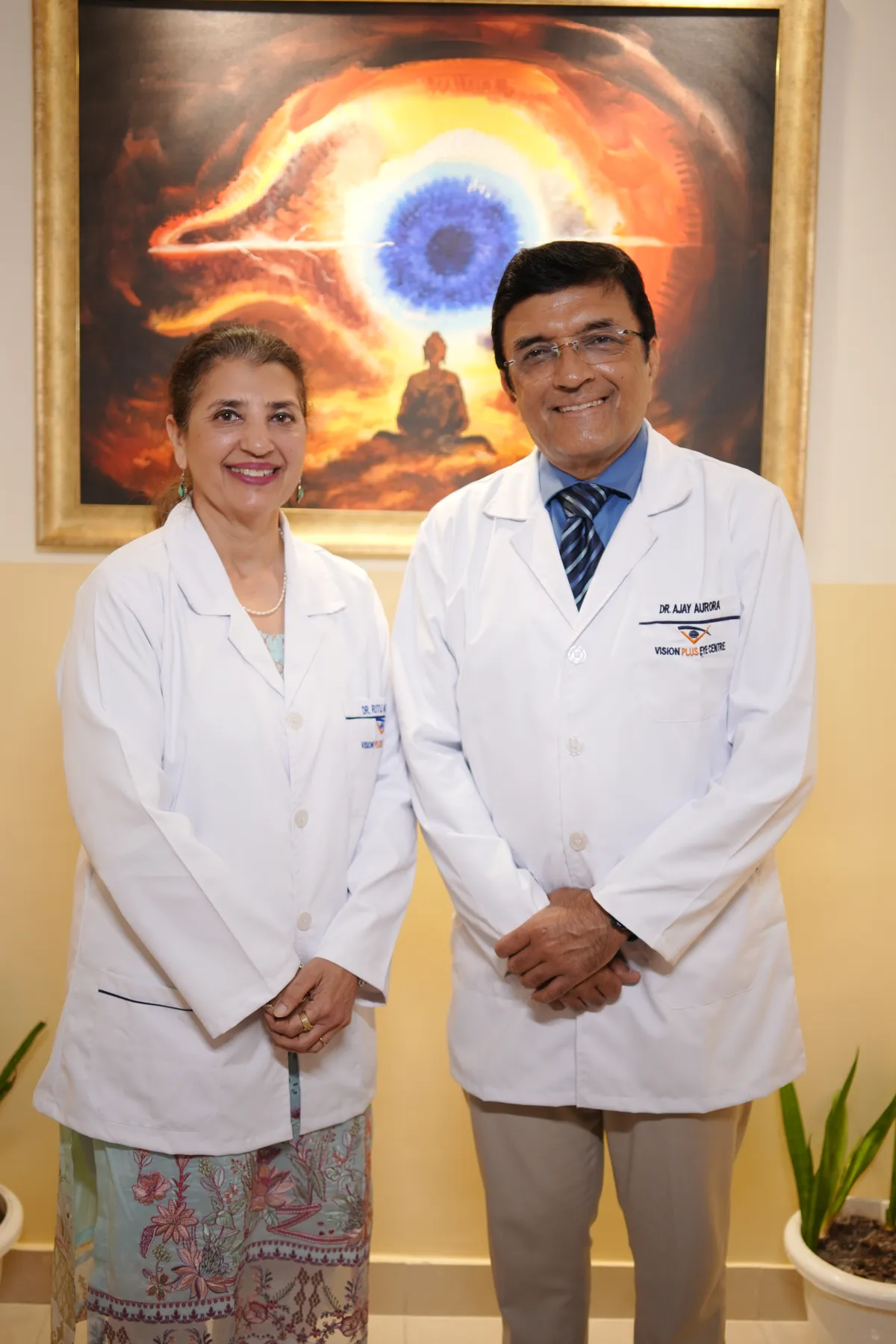
A retina specialist is an ophthalmologist who has trained further in diseases of the retina (the light-sensing layer at the back of the eye), the vitreous (the gel that fills the eye) and the uvea (the middle, blood-rich coat). At Vision Plus Eye Centre in Noida, retina care is led by Dr. Ajay Aurora, a leading medical and surgical vitreoretinal specialist. His special interests include diabetic retinopathy and retinopathy of prematurity (ROP).
Quick facts
- Retina diseases often cause no pain. A blurred patch, wavy lines, or new floaters are the usual first signs.
- Many retina conditions are treated without surgery: by injection, laser, or medicines.
- Anti-VEGF injections cost roughly Rs 12,000 to 35,000 per injection in Noida, depending on the drug. Full price table below.
Who is a retina specialist, and what do they treat?
A retina specialist treats disease of the back of the eye, using medicines, injections, laser and, when needed, surgery. A general ophthalmologist can find these problems, but treatment often needs the extra training and equipment of a retina service.
Dr. Ajay Aurora completed his MBBS in 1983 and MS in Ophthalmology in 1986 at JIPMER, Pondicherry, where he won the gold medal as the most outstanding postgraduate in ophthalmology, University of Madras. He did a retina fellowship at the Retina Foundation, Ahmedabad (1996 to 1997) and trained in retina, vitreous and uvea at the University of California San Diego (2000 to 2001). He led the AIOS instruction course on diabetic retinopathy in 2021 and is faculty for Vitreo-Retina and Uvea at AIOC 2026. Read his full profile on the Dr. Ajay Aurora page .
Retina conditions and how they are treated
The table below is a map, not a prescription. Your treatment depends on the stage and your scans.
| Condition | What is happening | Usual treatment |
|---|---|---|
| Diabetic macular oedema (swelling of the central retina) | Leaky vessels fluid-fill the macula | Anti-VEGF injection, steroid injection or implant, focal laser |
| Proliferative diabetic retinopathy | Fragile new vessels grow and can bleed | Panretinal laser, anti-VEGF, vitrectomy if bleeding persists |
| Wet (neovascular) age-related macular degeneration | Abnormal vessels leak under the macula | Anti-VEGF injections, often long-term |
| Dry age-related macular degeneration | Slow thinning of macular cells | Monitoring, home Amsler grid checks, selected supplements for intermediate stage |
| Retinal vein occlusion | Blocked vein, bleeding and macular swelling | Anti-VEGF or steroid injection, laser |
| Central serous chorioretinopathy | Fluid collects under the macula, often with stress | Observation first; laser in selected cases |
| Retinal tear or lattice degeneration | Weak or torn retina | Laser retinopexy to seal it before it detaches |
| Retinal detachment, macular hole, epiretinal membrane | Structural change in retina | Surgery; see retina surgery |
| Uveitis | Inflammation inside the eye | Steroid drops or injections, immune-modulating medicines, treat the cause |
| ROP in premature babies | Abnormal vessel growth in the baby's retina | Screening, laser or injection at the right window |
Tests used in the retina clinic
A retina examination starts with a dilated look at the back of the eye, and usually adds one or more scans.
OCT (optical coherence tomography). A quick, non-contact scan that makes a cross-section of the retina. It shows swelling, fluid, holes and membranes layer by layer, and is how we decide whether an injection is working. At VPEC, patients also have access to advanced ZEISS OCT angiography technology (Germany).
Fundus photography. A photograph of the retina, used to record the state of the disc, macula and vessels so changes can be compared over visits. VPEC is one of the few centres in India equipped with the latest MIRANTE widefield imaging system by NIDEK, Japan.
Fluorescein angiography. A dye is injected into an arm vein and photographs trace its path through the retinal vessels, revealing leakage and blockages. VPEC also offers ICG (indocyanine green) angiography and is one of the select centres offering this specialised test.
B-scan ultrasound. Used when the view is blocked by a cataract or blood. It shows whether the retina is attached.
These are some of the imaging options available at VPEC. Ask the front desk for the complete equipment list and current test costs.
Anti-VEGF injections explained
An anti-VEGF injection is a small dose of medicine placed into the gel of the eye to block VEGF (vascular endothelial growth factor), a protein that makes retinal vessels leak and grow abnormally. It is the main treatment for wet macular degeneration, diabetic macular oedema and macular swelling after vein occlusion.
What happens on the day. In the OT (operating theatre), you lie back. The eye is numbed with drops, cleaned with antiseptic, and a lid holder keeps the eye open. The injection itself takes seconds. You feel pressure rather than pain. You go home the same day, usually with antibiotic drops for a few days.
How many injections. A common plan is three monthly injections to start, then review with OCT. Some patients need further doses as needed or at stretched intervals (treat and extend). Others need only a few. Wet AMD is a long-term condition, so expect follow-up for years.
Which medicine. Several molecules are used: bevacizumab (lowest cost), ranibizumab, aflibercept, biosimilars of these, and newer agents. Steroid injections or implants are alternatives for certain swelling. The choice depends on diagnosis, response, cost and your general health. Dr. Aurora is also interested in the suprachoroidal route of injection and has designed devices for intravitreal and suprachoroidal delivery.
Risks. Common: redness, a small blood spot on the eye white, floaters for a day or two, gritty feeling. Rare but serious: infection inside the eye (endophthalmitis), retinal tear or detachment, a rise in eye pressure, and cataract with steroid use. Serious infection happens in well under 1 in 1,000 injections in published series, which is why strict sterile technique matters. Pain, falling vision or increasing redness after an injection needs a same-day visit.
Retinal laser
Retinal laser (photocoagulation) uses controlled light energy to seal leaking vessels, treat areas of poor blood supply, or weld the edge of a tear. It is a sitting of 10 to 20 minutes under drops, with a contact lens on the eye. You may see bright flashes and feel brief aching. Vision may be a little dim for hours. Laser does not restore lost vision; it protects what remains. Patients may need more than one sitting.
Uveitis: inflammation inside the eye
Uveitis is inflammation of the uvea, and it can cause redness, pain, light sensitivity, floaters and blurring. It can be anterior (front), intermediate, posterior (back) or all through the eye.
Causes include autoimmune disease (such as HLA-B27 related disease, juvenile arthritis), infection (tuberculosis, toxoplasma, viral), and sometimes no cause is found. The eye is treated with steroid drops, injections or tablets, and pupil-dilating drops to ease pain. Recurrent or severe cases may need immune-suppressing medicine, and we may request blood tests, a chest X-ray or a rheumatology opinion. Treating only the eye while missing the cause leads to relapse. Dr. Aurora lists uveitis among his main interests.
Macular degeneration treatment (AMD)
Macular degeneration damages the central retina, so reading and face recognition suffer first while side vision stays. Wet AMD needs anti-VEGF injections and usually responds if treated early. Dry AMD has no injection that restores vision; the plan is monitoring, quitting smoking, a healthy diet, and for the intermediate stage a supplement formula studied in large trials (AREDS2) if your doctor advises.
Check one eye at a time at home with an Amsler grid (a square of straight lines). If lines look wavy, broken or blank, book a visit within days: wet AMD can destroy central vision quickly.
When to see a retina doctor: red flags
Go to an eye hospital the same day for:
- A shower of new floaters (black dots, cobwebs), especially with flashes of light.
- A dark curtain or shadow moving across your vision.
- Sudden loss of vision in one eye.
- Straight lines suddenly wavy or a blank spot in the centre.
- Eye injury, or new pain and fall in vision after any eye surgery or injection.
Book a visit in the next week for: diabetes without a recent dilated exam, high myopia, family history of retinal detachment, or any slow blurring that glasses do not fix. If it is after hours, call +91 8800313134 or go to the nearest eye emergency.
Retina treatment cost in Noida
Prices vary by drug, number of sittings and whether tests are combined. The ranges below are indicative for Noida, per eye. Final quote after examination.
| Service | Indicative range |
|---|---|
| Retina consultation with dilated exam | Please call the desk for current consultation fees. |
| OCT scan | Rs 1,500 to 4,500 |
| Anti-VEGF injection | Rs 12,000 to 35,000 per injection (bevacizumab lowest; ranibizumab and aflibercept higher; biosimilars between) |
| Retinal laser (photocoagulation) | Rs 5,000 to 12,000 per sitting |
| Vitrectomy | Rs 50,000 to 1,20,000+ |
| Retinal detachment surgery | Rs 60,000 to 1,50,000 |
Price depends on the molecule, repeat injections, day care vs stay, complications and insurance packages. CGHS and cashless insurance support is available, confirm panel at the desk.
Prices reviewed: November 2026.
Frequently asked questions
What does a retina specialist do?
A retina specialist is an eye doctor with extra training in diseases of the retina and vitreous. They diagnose with OCT and imaging, treat with injections, laser and medicines, and operate when needed. Common patients: diabetics, people with macular degeneration, retinal tears or detachment, and those with uveitis.
When should I see a retina doctor?
See one urgently for sudden floaters, flashes, a dark curtain or sudden loss of vision. See one soon for wavy lines, a central blind spot, diabetes, high myopia, or slow blurring that glasses cannot fix. If you are not sure, an exam is quick, and early treatment often keeps vision that late treatment cannot.
Which tests will I need?
Almost every visit includes a dilated exam, and most include an OCT scan. Some need a fundus photograph, B-scan ultrasound, or fluorescein angiography to see leakage. Your doctor will only order what changes the plan. Dilation blurs near vision for a few hours, so bring sunglasses and a companion.
Are anti-VEGF injections safe?
For most patients, yes. They are a standard worldwide treatment. Common effects are redness and floaters for a day or two. Serious infection or retinal tear is rare but possible, so the procedure is done in sterile conditions. Report pain, worsening vision or increasing redness at once. Your doctor will explain the risks for your eye.
Does an eye injection hurt?
Most patients feel pressure, not sharp pain. The eye is numbed with drops first, and the injection takes seconds. You may feel a slight sting from the antiseptic, and a gritty eye later that day. Pain after the effect of the anaesthetic fades is unusual and should be checked.
How many injections will I need?
It depends on the disease. Many plans start with three monthly doses, then adjust by OCT. Diabetic swelling may settle in a few months; wet AMD often needs treatment for years at gaps that stretch with time. Skipping visits is the main reason treatment fails, so follow the schedule your doctor gives.
Can macular degeneration be cured?
No, but wet AMD can often be controlled if treated early with injections. Dry AMD cannot be reversed; the aim is to slow it with monitoring, no smoking, good diet and sometimes AREDS2-type supplements. Neither type causes total blindness, because side vision is usually kept, but central vision loss can be significant.
What is the cost of anti-VEGF injection in Noida?
Indicative range Rs 12,000 to 35,000 per injection, depending on the molecule. Bevacizumab is the lowest cost; ranibizumab and aflibercept are higher; biosimilars sit between. OCT and consultation are extra. Final quote is given after examination. CGHS and cashless insurance support is available; confirm panel at the desk.
Where can I see a retina specialist near me in Noida?
Book at Vision Plus Eye Centre, Kisan Tower, Sector 51, Noida (near Sector 51 metro), Monday to Saturday 9:30 AM to 7:30 PM, Sunday 10 AM to 4 PM. Or at Gaur City 1, Noida Extension, Monday to Saturday 10 AM to 7 PM. Call or WhatsApp +91 8800313134.
Book a retina consultation
Patients from Sector 50, 52, 62, 18, 76 and 128, Indirapuram, Crossings Republik, Ghaziabad, Greater Noida and Delhi East visit our Sector 51 centre; Greater Noida West and Gaur City patients can use the Noida Extension centre.
- Appointment desk and WhatsApp: +91 8800313134
- Eye surgery consultation: +91 9717417417
- Email: wecare@visionplus.net.in
- Sector 51: Kisan Tower, Capt Shashikant Sharma Marg, Hoshiarpur, Sector 51, Noida 201301
- Noida Extension: Shop 213, Aarza Square-2, Gaur City-1, Sector 4, Greater Noida West 201309
Medically reviewed by Dr. Ajay Aurora, November 2026