

Last updated: 7 November 2026
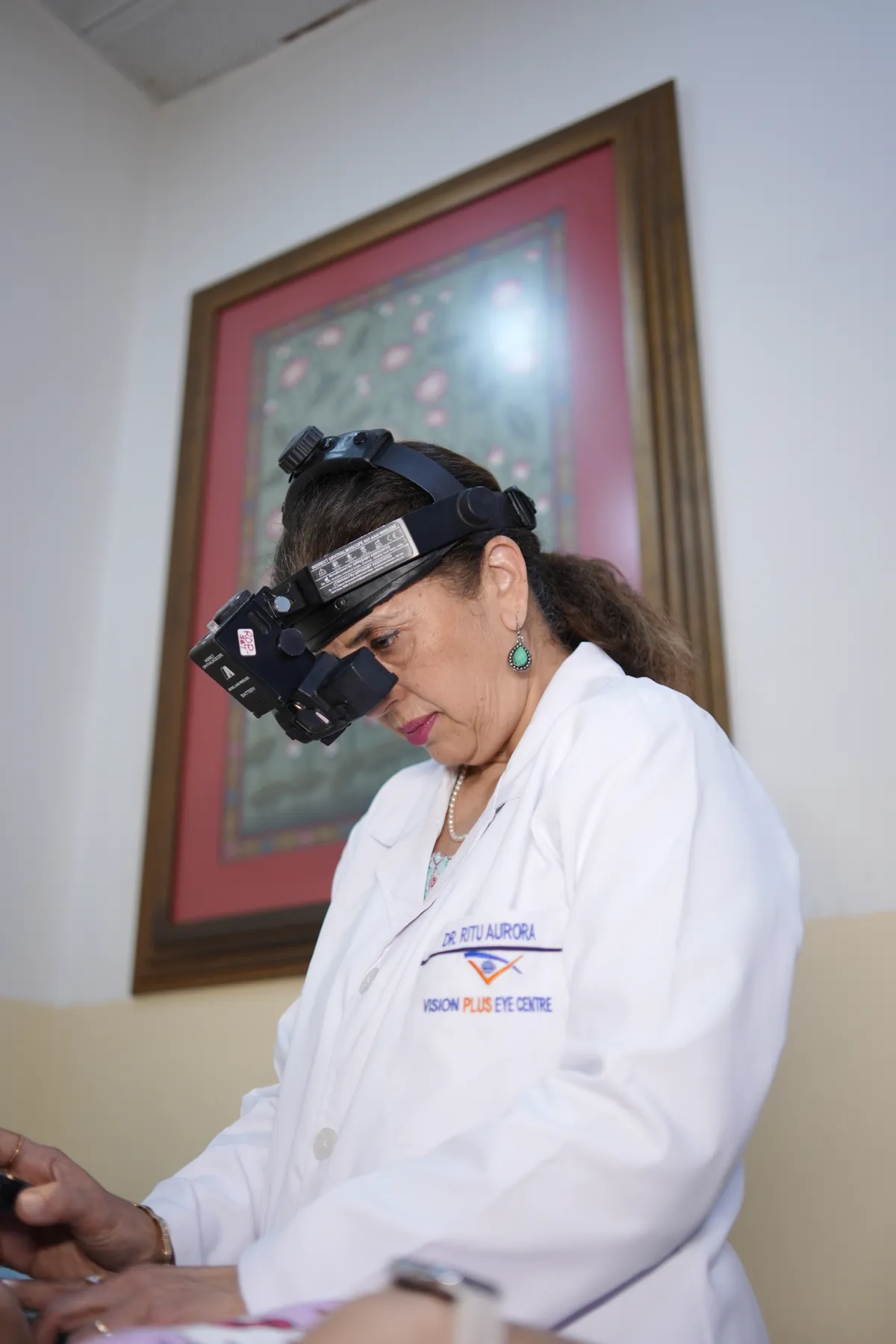
*Written by the Vision Plus clinical content team, medically reviewed by Dr. Ritu Aurora, November 2026.*
Normal eye pressure, also called intraocular pressure (IOP), is about 10 to 21 mmHg (millimetres of mercury). A reading above 21 is "high" and needs a closer look, but a single number does not diagnose glaucoma. Many people with readings in the normal range still have damage, and many with higher readings never do.
What is eye pressure?
Your eye is filled with a clear fluid called aqueous humour. It is made all the time and drains out through a mesh near the iris. When production and drainage balance, pressure stays steady. If drainage is blocked or slow, pressure rises and may harm the optic nerve over time.
Eye pressure ranges and what they may mean
| Reading (mmHg) | Usually described as | What it may mean | What to do |
|---|---|---|---|
| Below 10 | Low | Often harmless; can follow surgery, injury or inflammation | Tell your doctor if you have symptoms |
| 10 to 21 | Normal | Typical for most eyes | Routine check-ups |
| 22 to 29 | Raised | Possible ocular hypertension or early glaucoma | Full glaucoma work-up |
| 30 and above | High | Higher risk of nerve damage | Prompt treatment plan |
| 40 and above, with pain | Very high | May be acute angle closure | Emergency care |
These bands are guides. Your own target depends on your optic nerve, family history and other findings.
Why one reading is not enough
Eye pressure changes through the day, often by several points. It may be higher in the early morning, after drinking a lot of water quickly, with tight neck wear or after heavy straining. Doctors therefore check at different times or repeat readings before drawing a conclusion.
The thickness of your cornea also changes the reading. A thick cornea can make the pressure read higher than it truly is, and a thin one can make it read lower. This is why corneal thickness (pachymetry) is measured when glaucoma is suspected.
Can glaucoma happen with normal pressure?
Yes. In normal-tension glaucoma, the optic nerve is damaged even though the pressure stays within 10 to 21. Possible reasons include a fragile nerve and poor blood flow. Lowering pressure still helps. On the other side, ocular hypertension means higher pressure with a healthy nerve; these people are watched closely and treated if risk is high. Our page on glaucoma covers the types in detail.
How is eye pressure tested?
- Applanation tonometry: The gold standard. A small probe gently touches the numbed cornea.
- Air-puff tonometry: A quick screening test with no contact.
- Handheld rebound devices: Useful for children and bed-bound patients.
If the number is high, extra tests follow: optic nerve OCT scan, visual field test, gonioscopy (a view of the drainage angle) and pachymetry. Indicative fees are about Rs 1,500 to 4,500 for OCT, Rs 1,500 to 3,000 for a visual field and Rs 500 to 1,500 for pachymetry. Confirm current fees with the desk.
What can raise eye pressure?
- Family history of glaucoma
- Steroids in any form, including eye drops
- Diabetes and high blood pressure
- High myopia
- Age above 40
Noida note
Diabetes and high blood pressure are common in the Noida region, and both are linked to eye pressure and optic nerve risk. A routine check from age 40, or earlier if glaucoma runs in your family, takes little time.
When to see a doctor
Treat these as emergencies: sudden severe eye pain, red eye, blurred vision, halos around lights, nausea or vomiting, especially after dim light or a long period of close work. Otherwise, see an eye doctor if you notice gradual loss of side vision, if relatives have glaucoma or if you use steroids for a long time. Read what treatment can achieve in can glaucoma be cured .
Frequently asked questions
What is a normal eye pressure range?
Normal intraocular pressure is roughly 10 to 21 mmHg. Individual targets differ, and your doctor also considers corneal thickness and optic nerve health. A single reading outside this range is not a diagnosis, but it deserves a proper follow-up examination.
Can I have glaucoma with normal eye pressure?
Yes. Normal-tension glaucoma damages the optic nerve even when pressure is between 10 and 21. It is found through optic nerve scans and visual field tests. Lowering pressure further can slow progress, so regular follow-up is important.
What are the symptoms of high eye pressure?
Usually none, which is why it is called a silent problem. Very high pressure may cause eye pain, redness, blurred vision, halos around lights, headache or vomiting, and needs emergency treatment. Do not wait for symptoms in high-risk groups.
How is eye pressure measured and how much does it cost?
A tonometer measures it in a few minutes, either with a gentle probe or an air puff. It is usually part of a routine eye examination. Extra tests such as OCT or visual field are priced separately; ask the desk for current fees.
Get your eye pressure checked
A simple test can protect your sight. Visit our glaucoma service at Vision Plus Eye Centre, Sector 51, Noida, or Gaur City-1, Greater Noida West. Appointments and WhatsApp: +91 8800313134. Surgery consultation: +91 9717417417.
Medically reviewed by Dr. Ritu Aurora, November 2026